Egenco promised Malawians 31MW, then moved to pay lawyers K2.6bn three days later
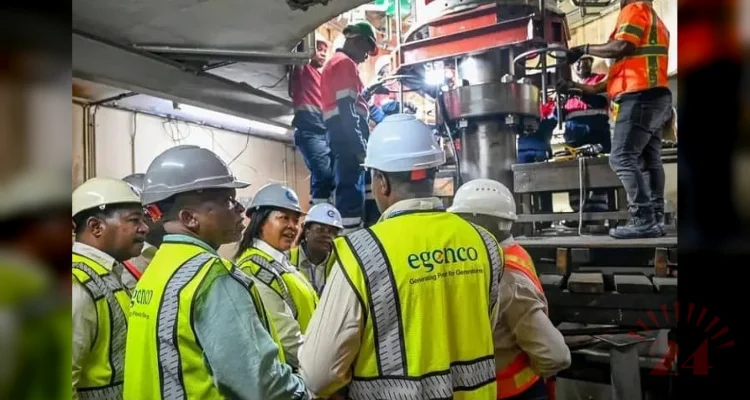
On October 20, standing at Nkula Power Station, Electricity Generation Company (Malawi) Limited (EGENCO) chief executive William Liabunya told Malawians that spare parts for broken generating machines would arrive before the end of the month and allow the company to restore 31 megawatts to a grid that cannot meet demand.
Three days later, on October 23, a handwritten note on Egenco’s copy of a law firm’s bill read: “Joshua, Pls proceed to pay as we await reimbursement from Escom.” The bill was for K2.62 billion.
While households sat in the dark, university students lost study hours to outages and a central and district hospitals were plunged into darkness, the state-owned generator was paying M&M Global Law Consultants a 15 percent fee for money that another state company, Escom, had paid straight into Egenco’s account. Documents first published online by whistleblower lawyer Alexious Kamangila show the firm’s contract priced its work at K75,000 an hour.
A grid that cannot keep the lights on
Malawi generates 564 megawatts, which “falls short of rising demand”, Energy Minister Jean Mathanga said on November 5. Civil society groups who engaged Egenco and the ministry in September put the shortfall at about 100 megawatts at morning and evening peaks. They blamed the loss of about 20MW at Nkula after a generator failure, reduced output at Kapichira because of transformer limits, and too few working diesel units.
Relief has been promised more than once. In July, Mathanga told Parliament that 80 megawatts from a battery storage system at Kanengo, the Nanjoka solar plant and a power link with Mozambique would cut blackouts by mid-August. By October 20 the Mozambique deal was still not finalised, and the new target for ending prolonged blackouts was December.
Who is paying in the dark
- Students: At the University of Malawi, students say daily outages are wrecking examination preparation, with laptops and phones dying before research projects can be finished. “During this examination period, we are failing to study due to persistent electricity outages,” said fourth-year student Collidah Kachale.
- Patients: At Rumphi District Hospital, a referral facility with no reliable backup power, outages disrupt patient care. “Whenever electricity goes out, the entire facility is plunged into darkness,” said council chairperson Alfred Butao.
- Businesses: In Phalombe, lodge owners have been forced to run costly generators, the district business association said.
- Protesters: The Human Rights Defenders Coalition has called demonstrations to demand the energy minister’s resignation over fuel shortages and blackouts.
Tough on others’ debts
The same power sector is unforgiving with other public bodies’ bills. In September, Escom gave the Blantyre Water Board 14 days to pay K1.6 billion or have power cut at its head office. The collection fee M&M billed on a debt between Escom and Egenco, K2.62 billion, is a billion kwacha more than the water board’s entire arrears.
That fee does not disappear into thin air. M&M’s letter bills Escom for it, and Egenco moved to pay the firm first and recover the money from Escom. Both companies are owned by government, and their costs are carried by electricity consumers and taxpayers. Critics of Egenco’s rented diesel generators have already warned that consumers could end up shouldering such costs through higher tariffs.
What K2.62 billion could fund
Set against Malawi’s own spending plans, the fee is the size of whole public projects. Using allocations in the 2026/27 development budget, as reported by Malawi24, and the cost of facilities recently built in Malawi:
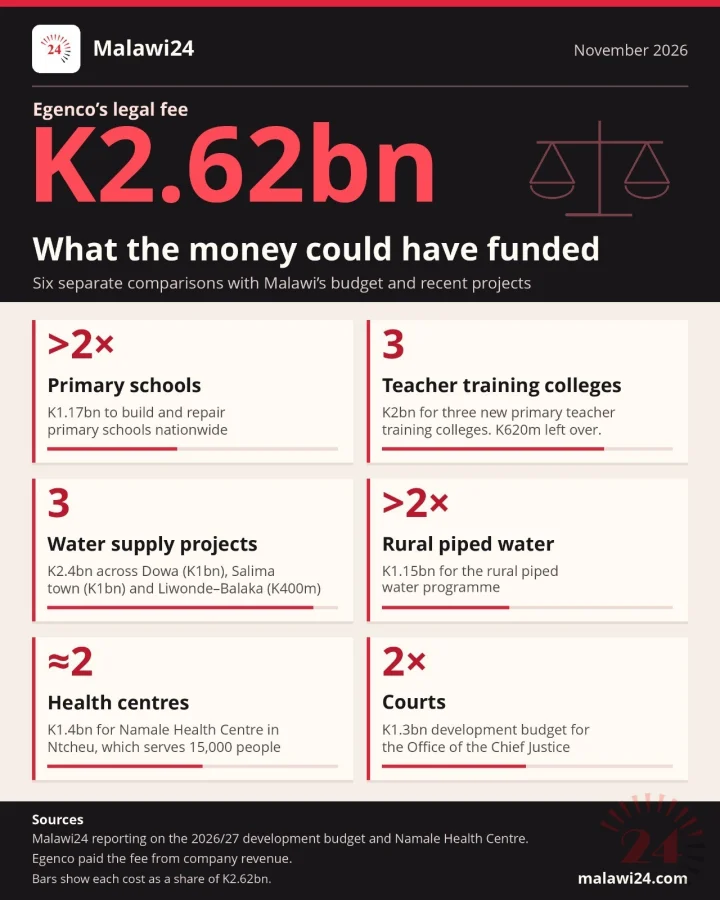
- Schools: more than twice the K1.17 billion allocated nationwide this year for building primary schools and rehabilitating education facilities.
- Teachers: the full K2 billion allocated for three new primary teacher training colleges, with K620 million left over.
- Water: the year’s allocations for both the Dowa District water supply (K1 billion) and the Salima town water supply (K1 billion), with enough left for the K400 million Liwonde and Balaka water project.
- Rural piped water: more than twice the K1.15 billion for the Ground Water Extraction for Rural Piped Water Development Programme.
- Health: close to two health centres like Namale in Ntcheu, a K1.4 billion facility expected to serve more than 15,000 people, or more than twice the K1.1 billion Chinsapo health centre extension in Lilongwe.
- Courts: twice the K1.3 billion development budget of the Office of the Chief Justice, including court building rehabilitation.
Egenco’s money is company revenue, not a budget vote, and there is no suggestion that funds meant for these projects went to the law firm. The comparison shows the scale of what two state power companies are paying to settle a debt between themselves.
Action only after exposure
Treasury has since ordered an investigative audit and the freezing of accounts linked to the payment. The Egenco board, chaired by Secretary to the President and Cabinet Justin Saidi, has suspended Liabunya, Director of Legal Services and Company Secretary Videlia Mluwira and Director of Finance Talimba Joshua Chapomba on full pay. None of them has been charged, and the investigations have yet to establish whether any wrongdoing occurred.
All of that came only after the documents were made public in mid-November, nearly a month after the payment was approved. For a company that has spent the year asking Malawians to be patient with blackouts, the question is how it found K2.6 billion for lawyers so quickly.
Efforts by Malawi24 to get comment from Egenco and M&M Global Law Consultants had not yielded any response by press time.