

Video: Mutharika returns after nearly a month in South Africa — when will he leave Malawi next?
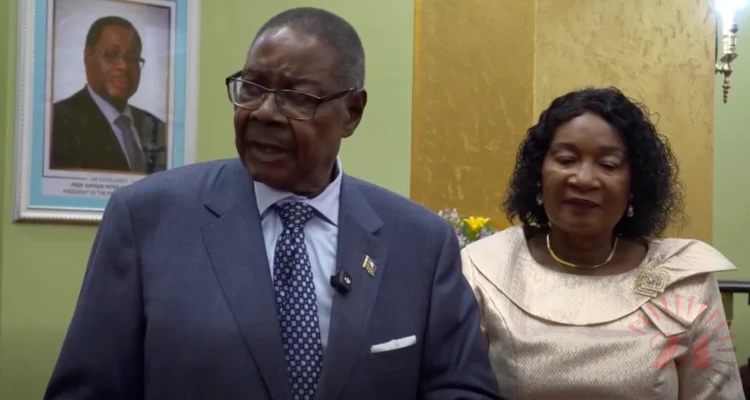

President Peter Mutharika has returned to Malawi after 25 days in South Africa.
His arrival through Kamuzu International Airport on Saturday, 31 October, ends his longest documented private visit to South Africa since returning to power in October last year.
Across five such trips, he has spent 77 days outside Malawi, earning him the nickname “the virtual president”.
Mutharika returns to a country struggling with fuel shortages, scarce foreign exchange and electricity disruptions. For households and businesses, the immediate questions concern how to keep moving, keep working and meet rising costs.
The President is back. The crises have not gone away.
Fuel queues have become a visible measure of the pressure facing the country. Motorists lose hours searching for petrol and diesel, while transport operators struggle to maintain services. Earlier this month, reports described truckers waiting up to a week for fuel and bus fares doubling on some routes.
Electricity disruptions compound the problem. A business without reliable power may turn to a generator, only to face another obstacle: finding fuel. The combination threatens working hours, production and income, while households face uncertainty over basic daily activities.
Speaking briefly to State House Press Secretary Cathy Maulidi at Kamuzu Palace in Lilongwe after his arrival, Mutharika thanked Malawians who had sent him messages and insisted he had remained in charge throughout his absence.
“I was in full control of the country and the government. I was in contact with the Chief Secretary sometimes 10 times a day and the ministers. I was in touch with the government and also the party. So nobody should complain,” he said.
Mutharika acknowledged the fuel crisis but blamed transport logistics, saying supplies were available in Tanzania.
“I know there are problems about fuel. We will take care of those. But the problem is beyond our control,” he said.
He also acknowledged the electricity shortages, saying repairs were underway and promising an end to the blackouts by December.
“I also know the problem with electricity, but we will take care of those,” he said. “Let’s just pull together for the sake of our country.”
Behind these difficulties lies the shortage of foreign currency needed to finance imports.
Malawi depends on imports for fuel and other essential supplies. The IMF has warned that foreign-exchange shortages constrain the country’s ability to import energy, food and fertiliser, leaving it less able to respond when domestic supplies fall short.
There are also fears that further pressure on the kwacha could deepen the squeeze.
Another devaluation would risk making imports more expensive in local currency, potentially feeding through to transport, production and household costs. However, government has denied that devaluation is being discussed in negotiations with the IMF. Information Minister Shadric Namalomba issued that assurance earlier this month. No confirmed devaluation decision has been announced in the reports reviewed.
Inflation remains a concern even though the annual rate has eased. Official figures put headline inflation at 19.4 per cent in September. Slower inflation means prices are increasing less quickly; it does not mean that earlier price increases have been reversed.
Against that backdrop, Mutharika’s repeated absences have sharpened questions about presidential priorities, public communication and accountability.
His latest trip began on 6 October. Government announced the departure after he had left, without explaining the purpose or giving the public an expected return date.
Independent airport video coverage has been restricted during departures and arrivals, with recorded footage instead shared through Mutharika’s Facebook page. The controlled appearances contrast with the public airport engagements associated with his first presidency and those of other presidents.
The result is limited opportunity for independent scrutiny or questions about the journeys.
Government’s response to demands for information has been blunt.
“Private is private. It is not public,” Chief Secretary Justin Saidi told The Nation, maintaining that details of the visits would not be disclosed.
But questions about the trips extend beyond their private purpose. Civil society organisations have demanded clarity over who pays for flights, accommodation, security, transport and diplomatic coordination. They have also sought explanations of how executive responsibilities are exercised during the President’s prolonged absences. Those demands do not establish who financed the journeys; they underline the information still being sought.
Mutharika’s documented visits ran from 1–15 December 2025, 1–12 March 2026, 12–29 June, 5–15 August and 6–31 October. Calculated consistently by subtracting each departure date from its return date, the five trips total 77 days.
His return closes the latest absence. It leaves unanswered questions about the journeys, their costs and the government’s response to the hardships confronting Malawians.
For now, Mutharika is home. When will he leave Malawi next?
More on Malawi’s fuel crisis: https://malawi24.com/tag/fuel/