
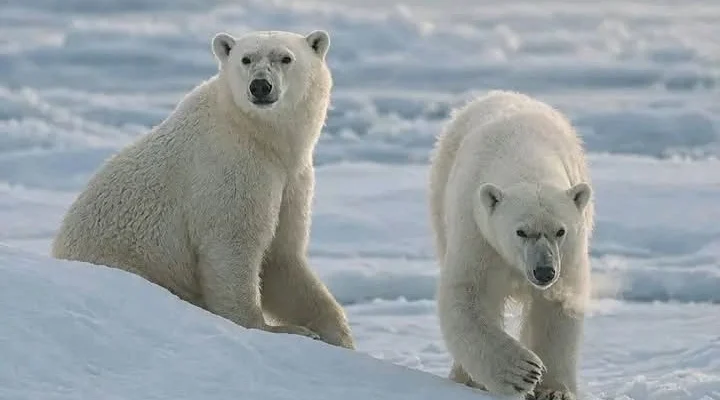
The polar bear is among the most extraordinary predators on Earth, combining immense physical strength with remarkable biological adaptations that enable it to survive in the freezing wilderness of the Arctic.
Beneath its familiar white-looking coat lies a fascinating combination of transparent hair, dark skin, thick body fat and specialised features that make this animal exceptionally suited to life in extreme cold.
Scientifically known as Ursus maritimus, meaning “sea bear”, the polar bear inhabits Arctic regions across Canada, Greenland, Norway, Russia and the United States.
Unlike many other large predators, it spends much of its life moving between frozen sea ice, coastal environments and icy waters in search of food.
One of its most fascinating characteristics is its apparently white fur.
Surprisingly, polar bear hair contains no white pigment.
Its outer guard hairs are colourless, translucent and hollow, while the shorter underfur provides an additional insulating layer.
The interaction of light with these hairs makes the animal appear white, helping it blend into snow-covered surroundings.
The coat is not simply a camouflage mechanism.
Its two layers trap insulating air, reducing heat loss and protecting the animal against freezing Arctic winds.
Beneath this extraordinary coat is another biological feature that often surprises wildlife enthusiasts: the polar bear has black skin.
The dark pigmentation is a genuine characteristic, although its precise contribution to heat regulation is more complicated than commonly suggested.
Scientists have traditionally explained that dark skin can absorb solar radiation that penetrates the fur.
However, research has questioned how much sunlight actually reaches the skin through the dense coat and whether pigmentation significantly increases the animal’s overall warmth.
This distinction demonstrates how scientific understanding of animal adaptations continues to develop.
Another essential survival feature is the thick layer of fat, commonly called blubber, beneath the skin.
This insulation helps preserve body heat, particularly when polar bears swim through extremely cold Arctic waters.
It also provides an important energy reserve during periods when food becomes difficult to find.
Their enormous paws are equally impressive.
Broad and powerful, they distribute body weight across snow and ice, while rough footpads and fur underneath provide additional grip.
Their partially webbed toes also help them move efficiently through water.
Polar bears are highly specialised carnivores, feeding primarily on ringed seals and bearded seals.
They use their exceptional sense of smell to locate prey, sometimes detecting seals hidden beneath snow or inside breathing holes in the ice.
Their ability to withstand freezing temperatures is particularly impressive because polar bears can experience Arctic conditions reaching approximately minus 40 degrees Celsius.
Their insulation is so effective that physically active adult males can sometimes overheat, even in extremely cold weather.
However, this remarkable predator faces a growing threat from climate change.
Arctic sea ice is essential for hunting, travelling and accessing seal populations.
As temperatures rise and ice melts earlier in spring and freezes later in autumn, polar bears have fewer opportunities to hunt and build the fat reserves needed to survive periods without food.
The International Union for Conservation of Nature’s Polar Bear Specialist Group identified 20 recognised polar bear subpopulations in its 2024 status report, with conservation concerns varying across different Arctic regions.
Beyond their extraordinary appearance, polar bears are important indicators of the health of the Arctic ecosystem.
Their survival depends on protecting sea ice, maintaining healthy marine environments and addressing the environmental pressures threatening their habitat.
The polar bear’s hidden black skin, translucent fur and powerful insulation demonstrate how evolution has equipped wildlife to survive extreme conditions.
Yet even the most remarkable natural adaptations cannot completely protect a species from rapid environmental change.
The greatest lesson from the polar bear is that nature’s most extraordinary survival designs also depend on a healthy environment.