
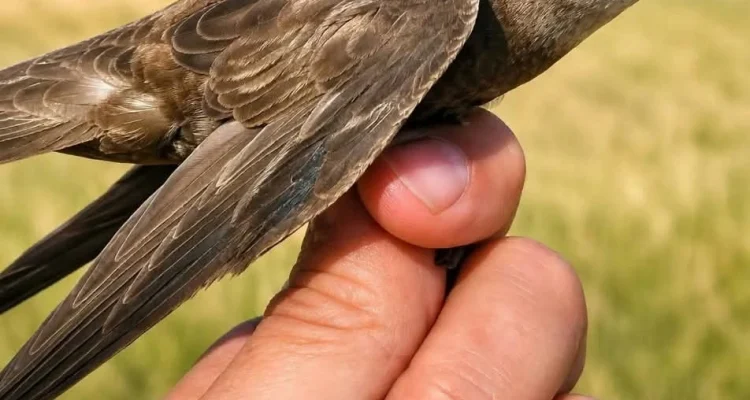
Scientists have uncovered one of nature’s most astonishing survival abilities after discovering that the common swift can remain airborne for nearly 10 months, travelling across continents without touching the ground throughout much of its non-breeding season.
The remarkable discovery, published in the scientific journal Current Biology in November 2016, identified the common swift (Apus apus) as one of the most extraordinary flying birds, with some individuals recorded spending their entire 10-month non-breeding period in continuous flight.
Researchers from Lund University in Sweden fitted 13 common swifts with miniature electronic tracking devices to monitor their movements and investigate how they survive for extended periods away from their breeding grounds.
The tracking results revealed that the birds spent more than 99 per cent of their 10-month non-breeding period airborne, while some individuals did not land even once during the observation period. Others made occasional brief stops, mainly at night, but still remained in flight for more than 99.5 per cent of the monitored period.
The findings confirmed the extraordinary aerial lifestyle of a bird that has evolved to perform almost every essential activity while flying.
Unlike many other species that depend on trees and branches for resting, common swifts capture insects in mid-air, gather nesting materials during flight and travel vast distances in search of food and favourable environmental conditions.
Their annual migration takes them from breeding grounds across Europe and parts of Asia to wintering areas in sub-Saharan Africa, before they begin the long return journey as the next breeding season approaches.
The journey requires exceptional endurance, particularly when the birds cross vast geographical regions, including the Sahara Desert, where changing weather conditions and food availability can influence their movements.
Researchers have also observed that common swifts climb to considerable heights around sunrise and sunset, a behaviour that occurs during their migration and wintering periods and offers further insight into their remarkable flight patterns.
One of the biggest unanswered questions concerns how the birds manage to sleep without landing. Scientists have suggested that they may take brief periods of rest while gliding, potentially using rising air currents to remain airborne with reduced effort.
However, the 2016 research did not directly establish that common swifts sleep during flight, leaving the precise mechanism of their aerial rest an important subject for further scientific investigation.
The birds eventually return to land during the breeding season, when they occupy sheltered nesting cavities in buildings, cliffs and other suitable locations to lay eggs and raise their chicks. After completing this reproductive cycle, they resume their largely airborne lifestyle.
Their extraordinary endurance has also raised important questions about how their bodies manage the energy demands of prolonged flight, maintain their feathers and withstand the physical pressures of spending months away from the ground.
For scientists, the common swift provides valuable insight into animal migration, flight performance and evolutionary adaptation, demonstrating how species can develop remarkable survival strategies over millions of years.
The discovery is a powerful reminder that some of the greatest wonders of the natural world are not found in distant oceans or unexplored forests but are flying above our heads.
A bird that can feed, travel across continents and remain airborne for almost an entire year represents one of nature’s most remarkable demonstrations of endurance.