
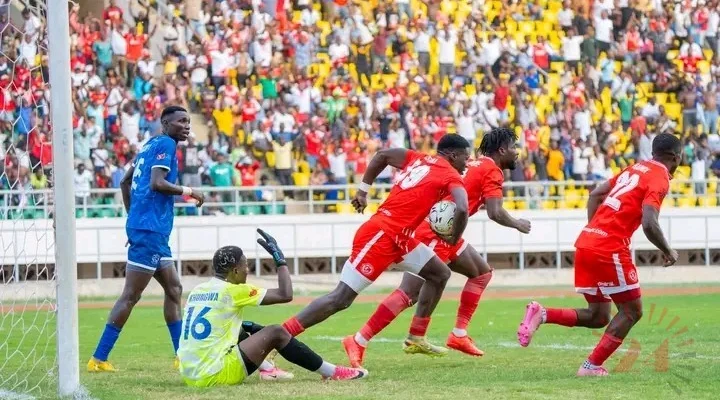
Bullets’ 2-1 victory over Mighty Wanderers in the FDH Premiership was a tactical battle that required more than individual brilliance to settle. Wanderers initially exploited weaknesses in Bullets’ defensive structure, but the contest gradually changed as Wedson Nyirenda introduced different attacking profiles, altered his team’s movement and used the technical qualities of his defenders.
Bob Mpinganjira’s side had the better attacking moments in the opening period, but Nyirenda’s interventions helped Bullets find different ways to threaten. From the change in the No.10 position to the introduction of two additional strikers and the involvement of centre-backs in attacking play, four tactical factors explain how Bullets turned the derby around.
1. 𝐖𝐚𝐧𝐝𝐞𝐫𝐞𝐫𝐬 𝐞𝐱𝐩𝐨𝐬𝐞𝐝 𝐭𝐡𝐞 𝐥𝐞𝐟𝐭
Wanderers began with a clear attacking plan, targeting Bullets’ left defensive channel through their right flank. Stanley Sanudi found opportunities to exploit Prince Chiumia’s positioning, while Dan Kudonto’s pass into the space behind the left-back helped create the opening goal.
Lameck Mithi capitalised on the opportunity to score in the 12th minute, rewarding Wanderers for identifying a weakness in Bullets’ defensive organisation.
The Nomads continued looking for opportunities in that area, but Bullets gradually improved their response. At 74 minutes, Chiumia demonstrated better defensive awareness by recovering from behind to deal with Gaddie Chirwa, winning the challenge against the attacking threat before playing the ball forward.
The improvement was important because it showed how Bullets were becoming more effective at dealing with a threat that had troubled them earlier.
2. 𝐓𝐚𝐜𝐭𝐢𝐜𝐚𝐥 𝐬𝐡𝐢𝐟𝐭𝐬 𝐜𝐡𝐚𝐧𝐠𝐞𝐝 𝐭𝐡𝐞 𝐠𝐚𝐦𝐞
Nyirenda’s most significant interventions came through changes in attacking roles and personnel. Bullets initially operated in a 4-3-3, with Wongani Lungu occupying the No.10 position. However, Lungu was a natural midfielder, offering a different profile from Maxwell Gasten Phodo, who replaced him in the 28th minute.
Although Phodo also operated as the No.10, his natural attacking instincts as a striker gave Bullets a more forward-oriented presence behind Tsimba.
The bigger adjustment came in the 58th minute when Nyirenda introduced Ephraim Kondowe and George Chaomba for Clever Kalambo and Misheck Billiat. Rather than simply replacing like-for-like wingers, he brought in two strikers to operate as wide forwards alongside Tsimba.
This changed the composition of Bullets’ front three, offering more direct attacking movement and additional threats around Wanderers’ centre-backs. The adjustment was immediately followed by the equaliser in the 59th minute.
Mpinganjira responded at 61 minutes by introducing natural striker Thierry Sama and midfielder Isaac Kaliati in an attempt to refresh Wanderers’ attacking options. However, Bullets had already found a different attacking dimension.
At 80 minutes, an injury to Phodo forced another adjustment, with young left winger Kondwani Tebulo coming on. Chaomba moved to the right while Tebulo occupied the left, allowing Bullets to maintain their attacking shape.
3. 𝐓𝐫𝐚𝐧𝐬𝐢𝐭𝐢𝐨𝐧𝐬 𝐚𝐧𝐝 𝐰𝐢𝐝𝐭𝐡
Bullets’ attacking threat became more varied as the match progressed, particularly through their use of the wide areas and quicker forward movements.
Mologeni’s overlapping runs down the right provided an important attacking outlet. His ability to get forward while also dealing with Nahipa defensively gave Bullets width without completely sacrificing their defensive responsibilities.
The movement of Bullets’ wide players also made it harder for Wanderers to concentrate their defensive attention on Tsimba alone. With Kondowe and Chaomba offering additional forward runs, the Nomads had more attacking threats to monitor.
The importance of quick transitions was also evident in the 67th minute. Following Nyasulu’s goal kick, Mpokera carried the ball past an opponent before finding Tsimba around the centre circle. Tsimba quickly released Phodo, who drove towards the penalty area but sent his effort over the bar.
Although the move did not produce a goal, it demonstrated the speed with which Bullets could turn a defensive restart into an attacking opportunity.
4. 𝐁𝐮𝐥𝐥𝐞𝐭𝐬’ 𝐝𝐞𝐟𝐞𝐧𝐝𝐞𝐫𝐬 𝐦𝐚𝐝𝐞 𝐭𝐡𝐞 𝐝𝐢𝐟𝐟𝐞𝐫𝐞𝐧𝐜𝐞
Perhaps the most interesting tactical distinction between the teams was how their centre-backs contributed to attacking play. Bullets’ Blessings Mpokera and Emmanuel Kaunga offered more than conventional defensive protection, using their positioning, passing and movement to influence attacks.
Mpokera’s vision was particularly evident in the build-up to the equaliser. From the left side of Bullets’ own half, he spotted Mologeni positioned on the right wing and delivered a long diagonal switch across the pitch.
The pass caught Wanderers’ defensive line unprepared. Mologeni received the ball on the right and sent a cross into the penalty area, where Tsimba rose to score with a powerful header in the 59th minute.
What made the move significant was not simply the distance of the pass, but Mpokera’s ability to recognise the space on the opposite flank before Wanderers’ defenders could adjust. Instead of progressing through crowded central areas, he changed the point of attack with one pass.
Kaunga provided another example of a defender contributing to attacking play in the 90+1st minute. He advanced from his centre-back position into the left channel, helping create the attacking situation that saw Tsimba head the ball across Wanderers’ defence. Chaomba arrived unmarked at the far post to score the winner.
The contrast was notable. While Bullets’ centre-backs contributed through progressive passing, switches of play and forward movement, Wanderers’ centre-backs appeared more focused on conventional defensive duties, with less influence in initiating attacks.
Mpokera helped create the equaliser, while Kaunga contributed to the move that produced the winner. Bullets’ defenders were not merely protecting their goal; they were helping decide the derby.
𝐀𝐝𝐚𝐩𝐭𝐚𝐛𝐢𝐥𝐢𝐭𝐲 𝐬𝐞𝐭𝐭𝐥𝐞𝐝 𝐭𝐡𝐞 𝐝𝐞𝐫𝐛𝐲
Wanderers demonstrated tactical purpose in the opening stages, particularly through their exploitation of Bullets’ left defensive channel. However, their early advantage became less influential as Nyirenda introduced different attacking profiles and his players found alternative ways to progress the ball.
The derby also exposed an important difference in how the two teams used their defenders. Bullets benefited from centre-backs capable of contributing to attacking progression, while their willingness to commit players forward created additional problems for Wanderers.
Nyirenda’s success was therefore not simply about making substitutions or finding a late goal. It was about changing the team’s attacking dimensions, responding to Wanderers’ strengths and using the technical qualities of his players to influence different phases of the game.
The 2-1 victory secured the bragging rights and opened a six-point gap over Wanderers in the FDH Premiership. More importantly, it demonstrated that modern defending is not only about stopping opposition attacks. The ability to read the game, progress possession and create opportunities from deep can be just as decisive in winning a football match.