
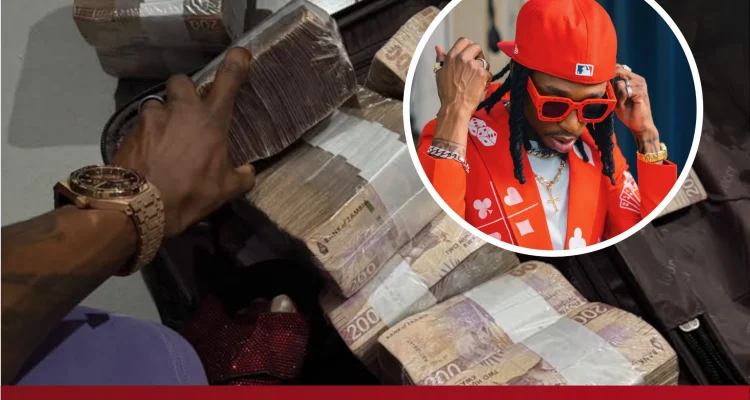
A Facebook post by Zambian music star Yo Maps, showing bundles of kwacha notes in a suitcase beneath the caption “My Degree” and a banknote emoji, has sparked debate in Zambia and Malawi about the value of formal education in an era when talent and enterprise can generate substantial incomes.
Published on Thursday, the post attracted more than 130,000 likes, 23,000 comments and nearly 1,000 reposts.
The “Finally” hitmaker, whose real name is Elton Mulenga, reinforced the message in the comments.
“Education is important but money is more important, money stops nonsense,” he wrote. His remarks drew both support and criticism from students, graduates, entrepreneurs and entertainment figures across southern Africa.
Commenters were divided over whether education remains the most reliable route to prosperity or whether talent, entrepreneurship and investment can offer a more rewarding path.
Among those defending education was Eunice Mwemba, whose Facebook profile identifies her as an undergraduate at the National Institute of Public Administration (NIPA).
She argued that wealth should be measured by what people own and invest in, rather than by what they display.
“Education remains undefeated,” Mwemba wrote. “Wealth is not always about how much money someone displays but what they own, how they invest, and how they build it quietly.
Rich people don’t keep their money in suitcases; their wealth is invested in assets such as properties, businesses, and other investments.”
Peter Chabinga, identified on his profile as a graduate of the Copperbelt University, expressed a similar view: “Education still remains undefeated.” His comment received more than 2,000 likes.
Many of the most popular responses, however, supported Yo Maps. Malawian media practitioner Howard Mlozi offered a practical argument: “We go to school, nurture talents and pursue careers to make money. Making money and living a better life is the essence of life.”
Morton Baghaya, whose real name is Bright Mhango, is a Malawian media figure known for promoting education and encouraging young people to stay in school.
He challenged critics with the question, “Who said school should bring money?” Mhango also argued that education had made the internet and trained professionals possible, pointing to the scientists who developed HIV antiretroviral medicines as an example of people whose education has helped save lives.
The debate reflects a long running frustration across the continent. Earlier this year, Africa Vibe Media summed up a sentiment increasingly expressed by young Africans:
“Education was meant to sweep away illiteracy, not poverty.” Across much of sub Saharan Africa, a qualification does not guarantee employment or financial security.
Labour market data illustrates the challenge. Figures reported from Zambia’s 2024 Labour Force Survey put unemployment at 9.5 per cent among bachelor’s degree holders and 11.7 per cent among certificate and diploma holders.
Although graduates appear to fare somewhat better than those with lower qualifications, the figures highlight the limited availability of jobs.
A separate peer reviewed study published through Springer in 2026 found that 52.5 per cent of Zambian university graduates were employed, with a median wait of 19 months before they secured their first job.
The wider continental picture is also difficult. The International Labour Organization (ILO) estimated Africa’s overall unemployment rate at about 7 per cent in 2024, while World Bank figures covering 51 African countries put the average at 8.9 per cent.
In 2023, the youth NEET rate, meaning the proportion of young people not in employment, education or training, stood at 21.9 per cent in sub Saharan Africa, compared with a global average of 20.4 per cent, according to the ILO’s Global Employment Trends for Youth 2024.
In South Africa, official statistics have also shown that people with education face poverty, challenging the belief that a degree guarantees escape from hardship.
In this context, earning a living through music, sport, sign writing and digital content can seem more attractive than pursuing a salaried career. Forbes’ 2025 ranking of the highest paid musicians reported that leading earners, including Taylor Swift, Bad Bunny and The Weeknd, made a combined $1.9 billion over 12 months.
Dr. Dre holds the record for the highest earnings by a musician in a single year, earning $620 million in 2014, largely through the sale of his Beats headphone business.
Yo Maps’ career also illustrates the importance of building wealth beyond earnings from music. Born Elton Mulenga on 29 November 1994, he has developed a sound combining Afrobeat, soul and traditional Zambian styles.
He has previously told Zambian media that real estate, rather than music alone, is his main source of income. This supports Mwemba’s argument that lasting wealth is often built through assets rather than displayed cash.
The debate also echoes arguments made by Kenyan public intellectual Professor PLO Lumumba.
In a university lecture last year, he contended that Africa’s inherited, foreign designed education systems had failed to foster economic independence and wealth creation because they were disconnected from practical needs such as agriculture, aquaculture and technology.
Lumumba also defended education as a means of developing the mind and promoting social equality.
However, he warned that education without discipline and practical application can produce what he called a “cunning fool”, a liability rather than an asset to society.
The suitcase photograph has become a focal point for a wider continental question: whether success should be defined by education, talent or wealth, and whether these can be combined.