
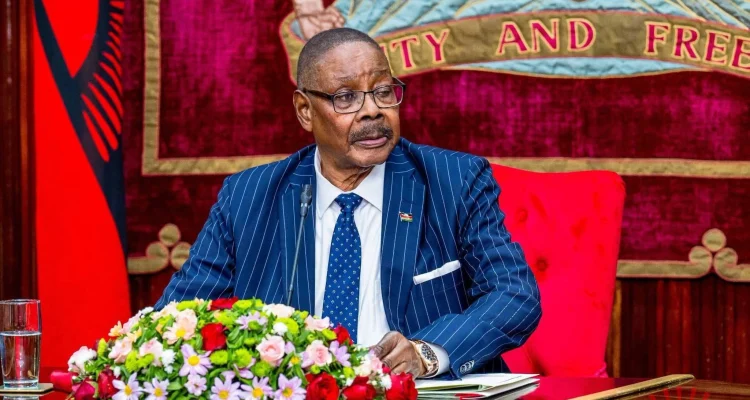
The statehouse has grown quiet, smelling of old paper and the cold comfort of linoleum corridors. Inside the inner sanctum sits the old man, Arthur Peter Mutharika, his breathing heavy and measured, a legal scholar trapped in a fortress of fading strength.
But outside his door, the air is thick with greed, the courtyard is alive with the snapping of jaws. They did not come to protect the republic; they came to slice up its corpse while the blood is still warm.
The inner circle has built a wall around the presidency, not to guard the leader, but to lock out the law. They speak in the riddles of thieves, assuring the dying nation that the rot inside the treasury is merely the natural order of things. As Malawi starves, they feast, carving out empires in the dark, confident that as long as they control the access to the frail old man, they control the destiny of millions.
Shadreck Namalomba, Minister of Information and Communication Technology, argues that because law enforcement agencies like the Anti-Corruption Bureau (ACB) have the mandate to investigate and prosecute criminal guilt, Parliament possesses no legal role in uncovering corruption. This misdirects the true purpose of legislative oversight.
Just because Parliament does not wield prosecutorial powers or throw thieves into jail cells does not mean it lacks investigative jurisdiction. Parliament investigates to enforce institutional accountability, discover policy failures, and safeguard public finances.
In fact, Section 60 of the Constitution of the Republic of Malawi, read together with Parliamentary Standing Orders grant the National Assembly absolute authority to conduct inquiries, compel the attendance of any public official, and subpoena documents concerning government operations.
Next, by translating politics strictly into “eating,” Victor Musowa, the Deputy Speaker of National Assembly normalizes political looting. It reframes public service not as a duty of custodianship, but as a zero-sum game of personal enrichment, signalling to public servants that state resources are meant to be consumed rather than managed.
The logic implies that because politics has historically been used for self-enrichment or systemic patronage, it is inherently an exercise in “eating,” rendering the vice acceptable.
A practice does not become morally or legally right simply because it is commonplace or traditionally expected by political syndicates.
Section 13 (o) of the Constitution of Malawi dictates that the State must introduce measures to guarantee the progressive exclusion of corruption in public affairs. Furthermore, the Corrupt Practices Act (Chapter 7:04) criminalizes the abuse of public office for private gain.
Norman Chisale once said, tikadzalowa mboma musadzayang’ane Peter kome ine. His assertion explicitly strips Mutharika of his constitutional executive authority. By telling supporters to look to the bodyguard rather than the head of state, he signals that the President is merely a ceremonial figurehead, while the true mechanisms of coercive state power reside in the hands of un-elected handlers.
Such assertion bypasses constitutional frameworks of authority and dictates power based on physical proximity and control over the executive infrastructure.
The truth is that political power in a democracy is derived from the electorate through constitutional offices, not through proximal control over an individual’s personal security detail.
Section 88 of the Constitution of Malawi declares that the President is the sole Head of State and Government, responsible for executive leadership. Power cannot be delegated or assumed informally by unelected personnel.
Peter Mukhito, the Secretary general of Democratic Progressive Party and Minister of homeland security released a memo in which he argued that because specific permanent institutions exist for law enforcement, the Speaker’s creation of ad hoc committees is an illegal encroachment on executive terrain.
Frankly speaking, the creation of ad hoc committees to probe public mismanagement is not an attempt to replace the courts or police, but an exercise of legislative scrutiny over failing government institutions.
Section 49 and Section 56 of the Constitution of Malawi empower the National Assembly to regulate its own procedures and appoint any committee necessary to execute its oversight mandate effectively.
Fortunately while an aged or ailing Peter Mutharika surrounded by a predatory cabal severely compromises the state, the institutional checks and balances—the Judiciary, Parliament, and civil society—still exist to mitigate that danger, provided those institutions refuse to be bullied.