

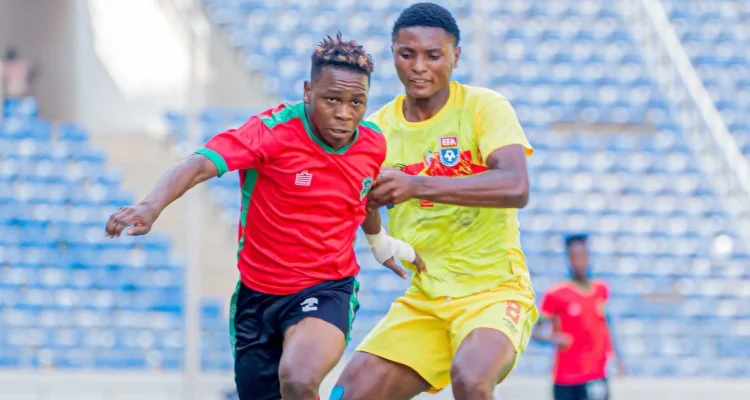
Malawi Under-23’s 1-0 defeat to Eswatini was not simply a story of missed chances. It was also a tactical battle in which Eswatini’s compact defensive structure repeatedly exposed weaknesses in Malawi’s 4-3-3.
From the opening stages, Eswatini used close, man-oriented marking to make Malawi’s build-up uncomfortable. Malawi had possession, but their players were often marked tightly, making it difficult to create passing lanes. This left striker Lucky Mkandawire isolated against two or three defenders on several occasions.
The clearest example came around the 4th minute, when Lucky was released but found himself alone against three Eswatini defenders. The situation showed the central problem with Malawi’s attacking structure: the striker was getting into useful positions, but the supporting players were not arriving quickly enough.
Malawi looked more dangerous when they combined through the middle and the half-spaces. The exchanges between Levison Mnyenyembe and Mwisho Mhango around the 27th and 31st minutes created better attacking situations, with Mwisho eventually shooting just wide of the far post. These combinations allowed Malawi to move around Eswatini’s marking rather than playing directly into it.
But those moments were not consistent enough. Malawi frequently attempted powerful forward passes that were difficult to control, while several promising attacks broke down because of heavy touches or rushed decisions. Eswatini were therefore able to recover their compact defensive shape.
The wide areas also presented an opportunity Malawi did not exploit consistently. With the wingers moving inside, Hemas Masinja and Edward Thengo could have provided more width through overlapping runs. Instead, Malawi often struggled to get their fullbacks high enough to stretch Eswatini.
Even when the crosses arrived, the movement inside the box was not coordinated. Around the 45th minute, Lumbe produced an excellent curling delivery, but nobody attacked the near-post area. Moments later, Masinja’s cross found several Malawian players crowded together near the near post while Levison Mnyenyembe arrived late at the far post.
Eswatini’s defensive discipline was a major reason for this. They protected the central areas, closed down the wide players with two defenders when necessary and avoided being dragged out of position. Their defenders were also comfortable dealing with Malawi’s high crosses.
After half-time, Malawi made a tactical adjustment by keeping Mwisho Mhango more centrally involved during build-up. This gave Oscar Petro more support in midfield. However, Blessings Kanowa increasingly stayed higher up the pitch, meaning Malawi still had moments where they lacked enough numbers in central midfield.
The frustration became more visible as the game progressed. At 57 minutes, Malawi were losing possession more frequently, and the rushed decisions continued. Eswatini, meanwhile, were becoming increasingly comfortable in possession and even began finding shooting opportunities around the edge of the box.
Malawi’s substitutions brought fresh energy. Chifundo Makawa replaced Lucky in the 63rd minute, while Misheck Billiat came on for Mnyenyembe. Later, Lasuli Jali and Lameck Mithi were introduced, with Mithi operating as the main striker.
However, the fundamental attacking problem remained. At the 69th minute, Kanowa received the ball alone inside the box but took too many touches, allowing the Eswatini defence to close him down. Malawi were reaching dangerous positions but were not making decisions quickly enough.
Then came the decisive moment in the 74th minute. Malawi lost possession in the attacking third after Mwisho’s touch became heavy. With several Malawi players already committed forward, Eswatini immediately launched a counter-attack.
Happy Mphepo did well to delay the first attacker inside the box, while Hemas Masinja and Washali Jaziya recovered quickly. But another Eswatini player found space around the edge of the box and Vilakati Sibonelo finished with a powerful first-time strike into the top corner, giving Julius Banda no chance.
The goal exposed the risk in Malawi’s attacking structure. Committing numbers forward is necessary when chasing a goal, but Malawi did not have enough protection around the central area when possession was lost. Eswatini needed only a few passes to turn Malawi’s attacking move into a scoring opportunity.
After conceding, Malawi became increasingly predictable. Around the 80th minute, Eswatini were sitting deep, closing the wide areas with two players and maintaining a compact midfield block. Malawi were repeatedly pushed towards crosses, exactly the type of attack Eswatini’s tall defenders were comfortable defending.
There were still opportunities. At 81 minutes, Jali released Mithi into the box. Mithi beat the goalkeeper but went wide and, instead of looking for Makawa, attempted to finish from a difficult angle. Again, Malawi had created an opening but failed to make the most effective final decision.
Eswatini almost doubled their lead in the 85th minute, when an excellent pass created a 2v2 situation. Their attackers entered the box and got a shot away, but Julius Banda produced an excellent save to keep Malawi within one goal.
Late crosses from Thengo and Billiat at 86 and 89 minutes were both dealt with by Eswatini’s defence, underlining how the visitors had successfully forced Malawi into predictable attacking patterns.
For the second leg in Mbabane on 6 October, Malawi Under-23 need more than greater possession. They need closer support around the striker, quicker midfield combinations, more coordinated runs in the box and greater variation in the final third.
The 4-3-3 itself is not the problem. The issue is how the players move within it. Against Eswatini, Malawi too often had the formation on the team sheet without the coordinated movement needed to make it function effectively.
From the opening stages, Eswatini used close, man-oriented marking to make Malawi’s build-up uncomfortable. Malawi had possession, but their players were often marked tightly, making it difficult to create passing lanes. This left striker Lucky Mkandawire isolated against two or three defenders on several occasions.
The clearest example came around the 4th minute, when Lucky was released but found himself alone against three Eswatini defenders. The situation showed the central problem with Malawi’s attacking structure: the striker was getting into useful positions, but the supporting players were not arriving quickly enough.
Malawi looked more dangerous when they combined through the middle and the half-spaces. The exchanges between Levison Mnyenyembe and Mwisho Mhango around the 27th and 31st minutes created better attacking situations, with Mwisho eventually shooting just wide of the far post. These combinations allowed Malawi to move around Eswatini’s marking rather than playing directly into it.
But those moments were not consistent enough. Malawi frequently attempted powerful forward passes that were difficult to control, while several promising attacks broke down because of heavy touches or rushed decisions. Eswatini were therefore able to recover their compact defensive shape.
The wide areas also presented an opportunity Malawi did not exploit consistently. With the wingers moving inside, Hemas Masinja and Edward Thengo could have provided more width through overlapping runs. Instead, Malawi often struggled to get their fullbacks high enough to stretch Eswatini.
Even when the crosses arrived, the movement inside the box was not coordinated. Around the 45th minute, Lumbe produced an excellent curling delivery, but nobody attacked the near-post area. Moments later, Masinja’s cross found several Malawian players crowded together near the near post while Levison Mnyenyembe arrived late at the far post.
Eswatini’s defensive discipline was a major reason for this. They protected the central areas, closed down the wide players with two defenders when necessary and avoided being dragged out of position. Their defenders were also comfortable dealing with Malawi’s high crosses.
After half-time, Malawi made a tactical adjustment by keeping Mwisho Mhango more centrally involved during build-up. This gave Oscar Petro more support in midfield. However, Blessings Kanowa increasingly stayed higher up the pitch, meaning Malawi still had moments where they lacked enough numbers in central midfield.
The frustration became more visible as the game progressed. At 57 minutes, Malawi were losing possession more frequently, and the rushed decisions continued. Eswatini, meanwhile, were becoming increasingly comfortable in possession and even began finding shooting opportunities around the edge of the box.
Malawi’s substitutions brought fresh energy. Chifundo Makawa replaced Lucky in the 63rd minute, while Misheck Billiat came on for Mnyenyembe. Later, Lasuli Jali and Lameck Mithi were introduced, with Mithi operating as the main striker.
However, the fundamental attacking problem remained. At the 69th minute, Kanowa received the ball alone inside the box but took too many touches, allowing the Eswatini defence to close him down. Malawi were reaching dangerous positions but were not making decisions quickly enough.
Then came the decisive moment in the 74th minute. Malawi lost possession in the attacking third after Mwisho’s touch became heavy. With several Malawi players already committed forward, Eswatini immediately launched a counter-attack.
Happy Mphepo did well to delay the first attacker inside the box, while Hemas Masinja and Washali Jaziya recovered quickly. But another Eswatini player found space around the edge of the box and Vilakati Sibonelo finished with a powerful first-time strike into the top corner, giving Julius Banda no chance.
The goal exposed the risk in Malawi’s attacking structure. Committing numbers forward is necessary when chasing a goal, but Malawi did not have enough protection around the central area when possession was lost. Eswatini needed only a few passes to turn Malawi’s attacking move into a scoring opportunity.
After conceding, Malawi became increasingly predictable. Around the 80th minute, Eswatini were sitting deep, closing the wide areas with two players and maintaining a compact midfield block. Malawi were repeatedly pushed towards crosses, exactly the type of attack Eswatini’s tall defenders were comfortable defending.
There were still opportunities. At 81 minutes, Jali released Mithi into the box. Mithi beat the goalkeeper but went wide and, instead of looking for Makawa, attempted to finish from a difficult angle. Again, Malawi had created an opening but failed to make the most effective final decision.
Eswatini almost doubled their lead in the 85th minute, when an excellent pass created a 2v2 situation. Their attackers entered the box and got a shot away, but Julius Banda produced an excellent save to keep Malawi within one goal.
Late crosses from Thengo and Billiat at 86 and 89 minutes were both dealt with by Eswatini’s defence, underlining how the visitors had successfully forced Malawi into predictable attacking patterns.
For the second leg in Mbabane on 6 October, Malawi Under-23 need more than greater possession. They need closer support around the striker, quicker midfield combinations, more coordinated runs in the box and greater variation in the final third.
The 4-3-3 itself is not the problem. The issue is how the players move within it. Against Eswatini, Malawi too often had the formation on the team sheet without the coordinated movement needed to make it function effectively.