

The House Without a Foundation: Nollywood Comes to Malawi after South Africa, But Are We Building an Industry or Chasing the Spotlight?

The Film Association of Malawi (FAMA) has announced plans to premiere the Nigerian film “Ikenga” on 26 November 2026 at the Bingu International Convention Centre (BICC) in Lilongwe, as part of the Malawi Film Awards and Gala. The event is expected to attract prominent Nigerian actors, including Patience Ozokwor, popularly known as Mama G, and Kanayo O. Kanayo, alongside other international film personalities.
On the surface, this appears to be an exciting development for Malawi’s film industry. It offers an opportunity for international exposure, networking and engagement with one of Africa’s most established film industries. There is, however, a bigger question that deserves attention: what does hosting a Nigerian film premiere contribute to the long-term development of the Malawian film industry?
More importantly, at a time when the local industry continues to grapple with fundamental structural challenges, are such high-profile international engagements receiving more attention than the work required to build a sustainable domestic film industry?
The question becomes even more significant following reports that Malawi has been selected to host the Pan-African Actors Round Table Awards (PARA). According to a report by Kwame Angus Nyirongo, the announcement was made during a joint press briefing at Nollywood Headquarters in Nigeria, attended by PARA President Dr Emeka Rollas, Nollywood President Dr Abubakar and FAMA President Dorothy Kingston. The awards are expected to bring together film professionals from across Africa to promote collaboration, networking and professional exchange.
The announcement also described the development as the beginning of a long-term partnership between Malawi and the Nigerian film industry. These developments suggest that Malawi is increasingly positioning itself as a destination for continental film engagements.
This ambition is not necessarily misplaced. International relationships matter, and the opportunity to connect Malawian practitioners with established African film industries should not be dismissed.
However, one would have expected an equally visible and deliberate commitment to strengthening the foundations of the industry that is expected to benefit from these engagements. The concern, therefore, is not about bringing Nollywood to Malawi.
It is about the priorities, timing and strategic purpose of doing so. An industry cannot be built merely by hosting prominent personalities, international premieres and continental awards. These activities may generate publicity and create opportunities, but their contribution to sustainable industry development must be demonstrated through tangible outcomes. When the international guests leave, what remains for the Malawian film industry?
FIRST THINGS FIRST: WHAT ARE THE FOUNDATIONAL CHALLENGES?
Malawi’s film industry continues to face several interconnected challenges. These include limited access to production financing, inadequate equipment and technical resources, insufficient professional development opportunities, weak distribution and exhibition structures, limited audience mobilisation and the difficulty of turning film production into a sustainable commercial activity.
These are not minor concerns that can be addressed through occasional international events. They are structural issues requiring sustained attention, investment and coordinated interventions.
Research conducted by Asso Prof Mufunanji Magalasi in a 2015 study titled “Factors Affecting the Growth of the Malawian Film Industry”, published in Journal of Development and Communication Studies identified several factors that have historically constrained the industry’s development. Among the issues discussed were the difficulties facing local film products in competing with foreign productions, the influence of imported films and weaknesses in the legal and institutional environment. Although the study was published more than a decade ago, many of the questions it raises remain relevant to contemporary discussions about the industry’s direction, including these recent steps.

The competitive environment has changed, particularly with the expansion of digital platforms and the growing accessibility of international content. Nevertheless, the fundamental question remains: how can Malawian films become sufficiently visible, accessible, commercially viable and competitive within their own market and beyond? This is where the conversation about industry development must begin. Before celebrating Malawi’s growing attractiveness as a destination for international film events, there is a need to examine whether the country is adequately investing in the people, productions, institutions and distribution systems that constitute its own film industry.
THE COPYRIGHT FUND: IS THIS THE BEST USE OF THE MONEY?
Perhaps one of the most important questions arising from the PARA announcement concerns the reported involvement of Malawi’s Copyright Fund. The announcement was accompanied by the acknowledgement, “Courtesy of the Copyright Fund of Malawi”. This raises a legitimate question about the purpose and utilisation of resources established to support the country’s creative and copyright industries. Is supporting Malawi’s hosting of a continental awards event the most strategic use of this money at this particular stage of the development of the local film industry? The question is not whether international exposure, professional networking or continental recognition has value. They certainly do.
The more important question is whether such engagements represent the most pressing priorities for an industry still grappling with inadequate production financing, limited distribution and exhibition infrastructure, weak audience development, insufficient professional development opportunities and the absence of a comprehensive institutional framework.
The Copyright Act of 2016 provides an important point of reference. Sections 99 and 107 identify the promotion of creativity and artistic skills, the preservation of works reflecting Malawi’s cultural identity, the creation of audiovisual works and the professional improvement of Malawian authors, performers, producers and publishers among the objectives and uses of the Fund. The provisions also recognise training, seminars and grants to creators as possible avenues for supporting the creative sector.
These provisions invite a closer examination of how funding decisions translate into tangible benefits for the people and industries the Fund exists to support. One would have expected substantial attention to be directed towards interventions that directly strengthen the capacity of Malawian filmmakers, support the production of local audiovisual works, improve their access to markets and create sustainable opportunities for copyright holders.
It would therefore be reasonable to ask COSOMA and the relevant Copyright Fund authorities to clarify the precise allocation made towards the PARA initiative, the activities it is intended to finance and the measurable benefits expected for Malawian practitioners. How many local filmmakers and actors will receive professional training or mentorship?
What opportunities will emerge for Malawian productions to access distribution markets, attract investment or enter into meaningful co-production arrangements? What mechanisms will ensure that the anticipated networking opportunities translate into actual professional and commercial outcomes?
These are not questions intended to undermine international collaboration. They are questions of accountability, strategic prioritisation and responsible resource allocation. Money drawn from a fund established to strengthen creative industries must be assessed not simply by the visibility of the events it supports, but by the extent to which it advances the interests and professional capacity of the creators it is meant to serve.
Malawi needs international connections, certainly, but it also needs to ensure that its own creative practitioners have the resources, skills, platforms and institutional support to benefit from those connections.
AUDIENCE DEVELOPMENT: WHO IS WATCHING MALAWIAN FILMS?
An industry cannot survive on production alone. It needs audiences. Films must be watched, discussed, shared, reviewed and supported by people who recognise their value. Yet audience development remains one of the areas requiring greater attention in Malawi’s film industry.
There is a need to understand more systematically how Malawians engage with local films, what influences their viewing choices, where they access films, what discourages them from watching local productions and what might encourage greater interest in home-grown stories. These questions should not be answered through assumptions or isolated observations.
They require sustained audience research and engagement with viewers across different age groups, geographical locations and social backgrounds.
Preliminary observations emerging from ongoing work on audience preferences raise important questions about the visibility and consumption of Malawian films. However, these observations should be treated as part of an ongoing investigation rather than conclusive evidence that Malawians do not watch their own films. It is also important to avoid reducing audience engagement to the quality of local productions alone. Storytelling, marketing, accessibility, distribution, language, cultural relevance, viewing habits and the availability of competing content all influence audience choices.
A film may be well produced but remain inaccessible to its intended audience because it lacks effective distribution or promotion.
Audience development must therefore become a deliberate industry strategy. Schools, colleges, universities, film societies, community organisations, festivals, radio and television can all contribute to cultivating interest in Malawian cinema. Digital platforms also provide opportunities, but their potential must be matched by deliberate audience mobilisation.
Watching a film online should not be the end of the engagement. Audiences can be encouraged to share, comment, recommend and participate in conversations about local productions. The industry needs to move beyond the assumption that producing a film automatically creates an audience. Audiences must be cultivated, understood and sustained.
LEARNING FROM LOCAL PRODUCTIONS: THE CASE OF “WELCOME TO MAULA PRISON”
There are already examples within Malawi that deserve closer examination when discussing the potential of local film production and audience mobilisation. One such example is 4Kaya Filmz’s “Welcome to Maula Prison”. The film’s Lilongwe premiere at BICC on 3 May 2025 attracted considerable attention, with tickets reportedly selling out in advance. The following day’s Blantyre screening at Mount Soche Hotel also drew a large audience, reported to have exceeded 1,000 patrons.
The production subsequently attracted audiences in Mzuzu and travelled beyond Malawi, with screenings in Johannesburg and Cape Town in South Africa in June 2025. The significance of this example is not that one successful production proves that Malawi has already developed a sustainable film industry.
Rather, it demonstrates why local productions, audience mobilisation, marketing, exhibition and international circulation deserve serious attention. What can the industry learn from the film’s promotional strategy?
How were audiences mobilised? What role did the production team, distribution arrangements, publicity and partnerships play in attracting viewers? What can be learned from taking a Malawian production to audiences in South Africa? Could similar strategies be adapted by other filmmakers?
These are practical questions that should inform industry development. Instead of treating successful premieres as isolated celebrations, the industry should study the processes behind them and identify approaches that can be replicated and improved.
SUPPORTING MALAWIAN PRODUCTIONS: THE “SONA” THREE-CITY PREMIERE
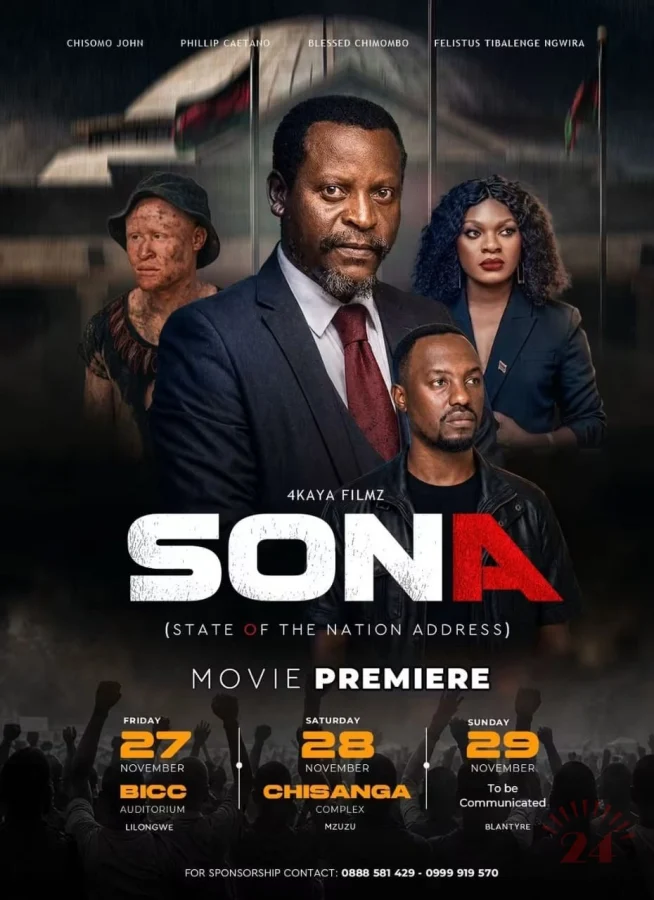
Another development worth examining is the announced three-city premiere of 4Kaya Filmz’s “SONA: State of the Nation Address”. The production is scheduled to premiere in Lilongwe on 27 November 2026 at the BICC Auditorium, in Mzuzu on 28 November at Chisanga Complex and in Blantyre on 29 November, with the venue yet to be announced. The announcement, presented under the message “Three cities. Three unforgettable nights. One powerful story”, is an interesting example of a local production planning to reach audiences across the country’s three major cities within a consecutive three-day period.
There is something particularly important about this approach. Rather than concentrating the premiere in one location, the production is seeking to take the film to audiences in different parts of the country.
This is the kind of domestic exhibition strategy that deserves attention, especially in an environment where access to commercial cinema facilities remains limited. Could such an approach inspire a more regular national exhibition circuit for Malawian films? Could local productions be screened beyond the major cities, reaching district centres, trading centres, schools, colleges, universities and communities?
Could partnerships with hotels, conference facilities, educational institutions and community organisations help establish more consistent screening opportunities? The timing is also concerning. “Ikenga”, the Nollywood film is scheduled Malawi premiere on 26 November, while “SONA: State of the Nation Address,” a Malawian film begins its three-city premiere the following day.

Both events coming at the same space of time. Is this strategy or a reflection of a house not united? Anyways, while “Ikenga” may have its place in the calendar, the domestic exhibition strategy behind “SONA”, which is a replication of “Welcome to Maula Prison” approach offers an opportunity to consider how local productions can mobilise audiences and expand their reach within Malawi. The important question is whether these initiatives can develop beyond individual premieres into sustainable distribution and exhibition arrangements. A film industry needs more than occasional screenings. It needs reliable ways of connecting productions with audiences and generating revenue for filmmakers.
DISTRIBUTION: BEYOND THE PREMIERE
One of the greatest challenges facing filmmakers in Malawi is what happens after a film has been produced and premiered. A successful premiere can generate publicity, attract audiences and provide an immediate opportunity for revenue. However, the long-term commercial life of a film depends on its ability to reach audiences through multiple distribution channels.
Malawi’s limited commercial cinema infrastructure makes it necessary to explore alternative and complementary exhibition models. Digital streaming platforms, television, physical video outlets, film festivals, community screenings and educational institutions could all play a role in expanding access to local productions.
At the Cape Maclear International Film Festival, an encouraging development was the encounter with young Malawian innovators presenting a locally developed indigenous streaming initiative “MaStreams” intended to host Malawian films and provide a means through which filmmakers could earn from their work. Such initiatives deserve attention because the future of Malawian cinema cannot depend exclusively on foreign platforms or occasional festival screenings.
There is also room to reconsider the role of physical video outlets. Properly licensed video shops could serve as distribution points for Malawian productions, provided that appropriate agreements are established to protect copyright holders and ensure that filmmakers receive their due revenue. This would require a structured approach involving producers, distributors, exhibitors and relevant copyright authorities.
Television offers another opportunity. Broadcasters could acquire or license Malawian films, establish dedicated local film slots, develop weekly film programmes and organise seasonal showcases. Such arrangements could provide filmmakers with additional revenue opportunities while increasing the visibility of local productions.
Community exhibition is equally important. Screenings in rural villages, trading centres, schools, community halls and other accessible venues could bring Malawian films to audiences who may not have access to conventional cinema facilities.
These screenings could also create opportunities for discussions around the social, cultural and developmental issues explored in the films. The objective should be to establish a distribution ecosystem in which a film can move from production to premiere, television, digital platforms, community screenings and international markets. Without such structures, even promising productions risk having a short commercial life.
INTERNATIONAL PARTNERSHIPS: WHAT HAS BECOME OF PREVIOUS COMMITMENTS?
International collaboration is important, but it should be measured by the outcomes it produces. This is particularly relevant when considering FAMA’s previous engagements with Nigerian film professionals.
In February 2025, FAMA signed a memorandum of understanding with Nigerian actors Charles Awurum, Charles Inojie and Nkeiruka Sylvanus, among others, with the stated intention of promoting film production, knowledge sharing and capacity building.
The announcement generated expectations about the possibilities of collaboration between Malawian and Nigerian practitioners. In April 2025, during the opening of FAMA’s first secretariat offices, Shepherd Bushiri reportedly indicated that he was awaiting feedback from FAMA on how it intended to proceed with the proposed collaboration involving the Nigerian actors.
The important question now is what tangible outcomes have emerged from those commitments. Have Malawian filmmakers received structured training or mentorship? Have any co-productions been initiated? Have local practitioners gained access to Nigerian production networks, distribution channels or investment opportunities?
What has been achieved, and what remains outstanding? The forthcoming “Ikenga” premiere and PARA engagement provide another opportunity to build on these relationships. However, they should not be treated as achievements in themselves. The value of international partnerships lies in what they enable local practitioners to do after the engagements have taken place.
For instance, a meaningful collaboration could involve Nigerian filmmakers working alongside Malawian production teams, providing practical mentorship, supporting co-productions, facilitating access to distribution markets or helping local productions reach audiences beyond Malawi.
These are the kinds of outcomes that would give international engagement a more enduring developmental purpose. The question should always be: what is Malawi gaining, and how are those gains being translated into stronger domestic capacity?
MAPPING AND DOCUMENTING THE MALAWIAN FILM INDUSTRY
Another foundational requirement is a comprehensive understanding of the industry itself. It is difficult to formulate effective policies, allocate resources or design interventions without reliable information about the people, institutions and activities that make up the sector. Malawi needs a systematic database of film practitioners, including directors, producers, screenwriters, cinematographers, editors, sound practitioners, actors, production designers, distributors, exhibitors and other professionals. Such documentation should also capture their professional experience, filmographies, geographical locations, technical capacities, available equipment, production activities and the challenges they encounter. This is particularly important for an industry whose history, activities and professional networks have not always been systematically documented.

A proper industry mapping and documentation exercise would help establish a clearer picture of the sector’s size, distribution, capabilities, gaps and development needs. It would also provide a basis for identifying practitioners beyond the established urban centres, ensuring that rural and emerging filmmakers are not excluded from industry development initiatives.
The work of documenting and mapping the Malawian film industry is an important area of ongoing research and engagement. It should be approached as a sustained national exercise involving filmmakers, professional associations, educational institutions, government departments, broadcasters, distributors and other stakeholders. Without reliable information, industry planning risks being driven by assumptions, individual interests and occasional activities rather than evidence.
PROFESSIONAL DEVELOPMENT: BUILDING THE PEOPLE WHO BUILD THE INDUSTRY
The development of a film industry also depends on the quality and availability of its human resources. Filmmaking is a collaborative practice requiring specialised knowledge and technical competence across several disciplines. A sustainable industry needs trained screenwriters, directors, producers, cinematographers, editors, sound professionals, actors and other practitioners who can work effectively within professional production environments.
The introduction and development of Film Production training within the Department of Film and Photography at the University of Malawi represents an important contribution to the growth of film knowledge and professional skills in the country.
Such academic programmes provide opportunities for students to engage with the history, theory and practice of filmmaking while developing the competencies required to participate in the audiovisual sector. However, university training alone cannot address every professional development need.
The industry also requires continuous professional development for practitioners already working in the field. There is a need for structured mentorship, specialised workshops, production attachments, technical training, professional exchanges and opportunities for emerging filmmakers to work alongside experienced practitioners. International engagements could contribute meaningfully here.
If Nigerian actors, directors, producers and other professionals are coming to Malawi, what opportunities will be created for local practitioners to learn from them? Could workshops, masterclasses, production demonstrations and structured mentorship be incorporated into the programme? Could emerging Malawian filmmakers be connected to professionals who can support their development beyond the duration of the events?
The presence of established international personalities should create opportunities for knowledge transfer, not simply photographs and ceremonial appearances.
GOVERNMENT POLICY AND THE NEED FOR A NATIONAL FILM FRAMEWORK
The development of a sustainable film industry cannot rest solely on the efforts of filmmakers and professional associations. Government has an important role to play in creating an enabling environment for the sector. Malawi needs a comprehensive national film policy that clearly defines the country’s priorities, institutional responsibilities and strategies for developing the film and audiovisual industries. Such a framework should address production financing, professional training, copyright protection, distribution, exhibition, film preservation, investment incentives, international market access and the development of local content.
There is also a strong case for considering the establishment of a dedicated national film commission or an equivalent institution with a clear mandate to coordinate industry development. Such an institution could facilitate local and international productions, promote Malawi as a filming destination, support industry research, encourage investment, strengthen distribution networks and coordinate opportunities for professional development.
A national film commission should not simply become another administrative office. Its value would depend on its mandate, professional capacity, accountability and ability to deliver measurable outcomes for the industry.
The wider creative economy agenda also provides an opportunity to advance these discussions.
The Creative Economy and Investment Forum scheduled for 25–27 November 2026 at BICC in Lilongwe, under the theme “Repositioning Malawi’s Creative Economy for Investment, Jobs and Economic Growth”, is expected to address issues including access to finance and equipment, business skills, distribution and the monetisation of intellectual property.
This is an important opportunity for the film sector. However, the value of such a forum will ultimately depend on what follows the discussions. The industry needs concrete commitments, responsible institutions, implementation timelines and mechanisms for monitoring progress. Speeches, photographs and declarations of support are not substitutes for practical interventions.
THE CORPORATE SECTOR: WHERE IS PRIVATE-SECTOR INVESTMENT?
The private sector also has an important role in building a sustainable film industry. Banks, telecommunications companies, hospitality businesses, advertising agencies and other corporate organisations could contribute through sponsorship, investment, production partnerships, product placement, distribution and support for professional development.
Malawi’s corporate sector already demonstrates its capacity to support activities that attract public attention and generate commercial visibility, particularly in sports and entertainment. The film industry should explore how similar partnerships can be developed to support local productions and the wider audiovisual ecosystem.
Corporate sponsorship should not be limited to awards ceremonies and premieres. Companies could invest in film production, sponsor emerging filmmakers, support film festivals, finance training programmes and partner with broadcasters and digital platforms to increase the circulation of Malawian content.
There is also an opportunity to develop mutually beneficial relationships in which filmmakers gain access to financing and distribution while corporate organisations benefit from advertising, brand visibility and association with locally relevant stories. The challenge is to move from occasional sponsorship to a more structured relationship between the creative industries and the private sector.
FAMA: FROM PROFESSIONAL ASSOCIATION TO STRATEGIC INDUSTRY LEADERSHIP
FAMA occupies an important position in the development of Malawi’s film industry. Established in 2011, the association has a responsibility to represent the interests of filmmakers, promote professional standards, advocate for better working conditions and contribute to the development of a sustainable film environment.
The opening of its first secretariat offices in April 2025 was an important institutional development. Having a physical office can improve coordination, accessibility and the association’s ability to engage with stakeholders. However, an office alone does not make a professional association effective. What matters is the strategy, leadership, membership engagement and measurable work taking place within and beyond it.
There is a need for FAMA to articulate a clear medium- to long-term strategic plan that identifies the most pressing challenges facing the industry, establishes priorities and outlines how the association intends to address them.
Such a plan should be developed through meaningful consultation with filmmakers and other stakeholders, rather than being driven exclusively by the activities of a few individuals.
The association should also communicate regularly with its membership and the wider industry about its activities, partnerships, funding arrangements, achievements and outstanding commitments. Where resources are obtained for industry development, members and stakeholders should be able to understand how those resources are being used and what outcomes are expected. A three- to five-year strategic framework, supported by annual work plans and transparent reporting, would provide a useful basis for assessing progress. It would also help distinguish between activities that generate visibility and interventions that contribute directly to industry development.
FAMA deserves recognition for pursuing international relationships and seeking to position Malawi within the wider African film landscape. Nevertheless, the association should also be prepared to answer difficult questions about the tangible benefits of its initiatives. This is not an attempt to undermine its leadership. It is a necessary part of institutional accountability and professional growth. The association’s success should ultimately be measured not by the number of international personalities it brings to Malawi, but by how much stronger the Malawian film industry becomes under its representation.
WHAT SHOULD MALAWIA’S INTERNATIONAL ENGAGEMENTS ACHIEVE?
There is no reason Malawi should avoid international film events, partnerships or collaborations. In fact, the country should actively pursue opportunities to connect its filmmakers with established African and global audiovisual markets. However, the direction of engagement matters.
Malawi should not aspire merely to become a destination for foreign film premieres and continental celebrations. It should also aspire to become a country whose own productions travel, attract audiences, secure distribution agreements, generate revenue and participate meaningfully in international markets.
The experience of Nigeria offers an interesting point of comparison. Its film industry has developed a substantial domestic market and increasingly visible international commercial presence.
Recent Nigerian box-office figures demonstrate the commercial potential of a film industry supported by established audiences and distribution networks. In 2026, “Call of My Life” reportedly grossed about ₦719.8 million, while “Love and New Notes” earned approximately ₦400.5 million.
More recently, “Agbara Nla: The Return” surpassed ₦450.3 million by 2 November 2026, according to newspaper reports citing its distributor. These figures illustrate the importance of developing domestic audiences, effective distribution and exhibition systems, and strategic film marketing. Although Malawi operates on a different market scale, the lesson is clear: a sustainable film industry must build a strong market for its own productions.
The lesson is not that Malawi can reproduce the Nigerian model overnight. The two industries have different histories, market sizes, institutional environments and levels of investment. Rather, the comparison highlights the importance of developing a strong domestic market and the structures required to sustain production and commercial circulation.
International partnerships should therefore be designed to support local priorities. If PARA is coming to Malawi, what lasting professional and commercial relationships will emerge? If Nigerian actors are participating in the Malawi Film Awards and Gala, what opportunities will be created for Malawian actors and filmmakers? If the country is receiving international attention, how will that attention be converted into investment, production, distribution and market access for local content? These questions should form part of the planning and evaluation of every major international engagement.
BUILDING THE HOUSE BEFORE INVITING THE WORLD
The announcement of “Ikenga”, the reported selection of Malawi to host PARA and the wider interest in positioning the country within the African film landscape should be seen as opportunities.
They can contribute to networking, visibility and international collaboration. However, these opportunities must be placed within a broader and more deliberate strategy for developing the domestic film industry. There is a need to strengthen local production, cultivate audiences, establish sustainable distribution channels, support professional development, document the industry, improve institutional capacity, encourage private-sector investment and develop a comprehensive national policy framework. These are the foundations upon which meaningful international engagement can be built.
The forthcoming Creative Economy and Investment Forum, the scheduled premieres of “Ikenga”, and the planned PARA engagement all present opportunities to advance the conversation. The real test will be whether these activities lead to practical commitments that remain relevant long after the events have ended.
One would have expected the growing interest in bringing international film personalities and continental events to Malawi to be matched by equally visible efforts to take Malawian films and filmmakers to the rest of Africa. The country should be building relationships that allow its creative practitioners to participate in international productions, access new markets, secure investment and tell Malawian stories to wider audiences.
There is a difference between hosting an industry and building one. Hosting can generate excitement for a few days, but building requires consistent investment, planning, institutional commitment and accountability over several years. We do not have to keep bringing big things to Malawi. We must build big things in Malawi and take them to other places. That is growth.
That is development. That is sustainability. That is impact. That is legacy. When Malawi has built an industry strong enough to stand on its own, Nollywood, South Africa and the rest of the world will not merely come to Malawi for premieres and celebrations. They will come to collaborate, invest, distribute, produce and do business with a film industry that has something substantial to offer. A house without a foundation cannot stand, no matter what we build upon it.
These are just but, the reflections of a concerned stakeholder!
Solomon Idyo is a Film Production lecturer and researcher in the Department of Film and Photography, University of Malawi. His research interests include African indigenous-language filmmaking and emerging film and audiovisual industries (currently researching Malawi’s emerging cinema industry).