

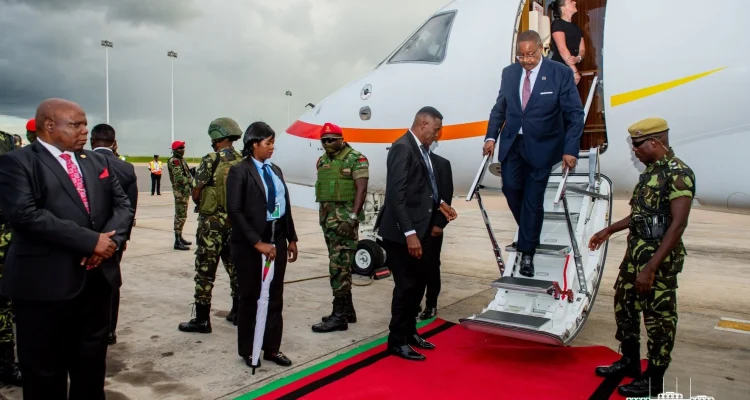
Malawi President Peter Mutharika has been blasted over his directive to postpone Parliament. Commentators say Mutharika is plunging Malawi into a “constitutional crisis” with his directive. They argue that the President cannot unilaterally order the Speaker to postpone an ordinary parliamentary meeting.
The letter has also exposed disquiet within government. Cabinet sources told Malawi24 that the directive had sent shockwaves through sections of the administration and ruling Democratic Progressive Party (DPP).
“Malawi is not at war, nor in a state of emergency. This needs to be challenged. Yes, I am in government, but we cannot hold the country to ransom like this,” one senior Cabinet official said. The official spoke on strict condition of anonymity because she is not authorised to speak on behalf of the government or President despite her seniority.
Dated 23 October 2026, the letter bears Mutharika’s name and signature and instructs the Speaker to postpone the fourth meeting of the 52nd session until the next Budget Meeting.
“By virtue of the provision under Section 59(1) of the Constitution of the Republic of Malawi, I direct that the Fourth Meeting of the 52nd Session of Parliament be postponed until the next Budget Meeting,” reads the letter which Malawi24 is yet to independently authenticate as to who actually drafted and authorised it. Some Cabinet sources questioned whether the instruction originated with Mutharika. They alleged that a minister acting as a de facto president during his absence was behind it. They supplied no documentary evidence establishing that allegation.
Opposition members who spoke to Malawi24 separately alleged that the postponement was intended to shield Mutharika from appearing at Parliament because of his alleged ill health.
Mutharika’s medical condition remains unverified. While Section 59(3) requires the President to open a parliamentary session, rather than every meeting within that session, the letter concerns the fourth meeting of an existing session, so postponement alone would not establish an attempt to avoid a constitutionally required opening appearance.
The central constitutional question concerns the President’s words: “I direct.” Section 59(1) assigns responsibility for appointing the commencement of an ordinary meeting to the Speaker, acting in consultation with the President.
“Every meeting of the National Assembly shall be held at such place within Malawi and shall commence at such time as the Speaker of the National Assembly, in consultation with the President, may appoint,” it states.
The provision also gives the President power to prorogue the Assembly—but expressly requires “consultation with the Speaker”.
The circulated letter does not explain what consultation preceded its instruction. That omission does not prove none occurred, but leaves unanswered whether the Speaker exercised the constitutional responsibility assigned to the office.
The document invokes disaster response and fuel shortages to justify the delay.
“This postponement is to enable the Government to dedicate financial resources to deal with the ongoing El Nino and the fuel situation,” it states.
Yet disaster financing arrangements already existed. According to the International Food Policy Research Institute, the 2026/27 budget allocated K590 million to disaster risk management, although operational expenses consumed most of it, leaving K114 million for substantive interventions. This allocation was only one component of wider disaster financing.
A government El Niño preparedness plan published on 5 October estimated requirements at K488.5 billion. It reported K163.7 billion mobilised through existing government and partner projects, leaving a K324.8 billion gap. The letter neither quantifies the savings from postponing Parliament nor explains how they would address that shortfall.
MP Ayuba James has meanwhile alleged that four senior ministers wanted the mid-year budget review, scheduled for 9 November, delayed because they feared opposition questioning over corruption, governance and the economy. He has not named them or substantiated the alleged plot.
Ireland-based legal scholar Alexious Kamangila described Malawi as “a country on Auto-Pilot” on Facebook when he shared screenshort of the presidential directive. Likewise, commentator Onjezani Kenani posted: “Oh?”
Four days earlier, amid mounting speculation about Mutharika’s health, South Africa-based law professor Danwood Chirwa demanded transparency. “The President’s health is a constitutional matter requiring full transparency. If he is incapacitated, power must be handed to his lawful successor, and if he is simply absconding from his duties, he should be impeached!” Chirwa wrote.
Mutharika left Malawi on 6 October for his fifth publicly announced private visit to South Africa since returning to office.
Homeland Security Minister and DPP secretary general Peter Mukhito has rejected claims of incapacity. He said he met Mutharika on 23 October and found him cheerful and in good health. Allegations that the President is being treated at a military hospital have not been independently verified.
Parliament continued its work during COVID-19, despite temporary disruption. Its February 2021 budget review was delayed by two weeks before proceedings resumed through physical and virtual participation.
The current letter proposes a much longer interruption to full Assembly scrutiny, without specifying a return date beyond the next Budget Meeting—as Malawians endure fuel shortages, forex scarcity and persistent blackouts.