
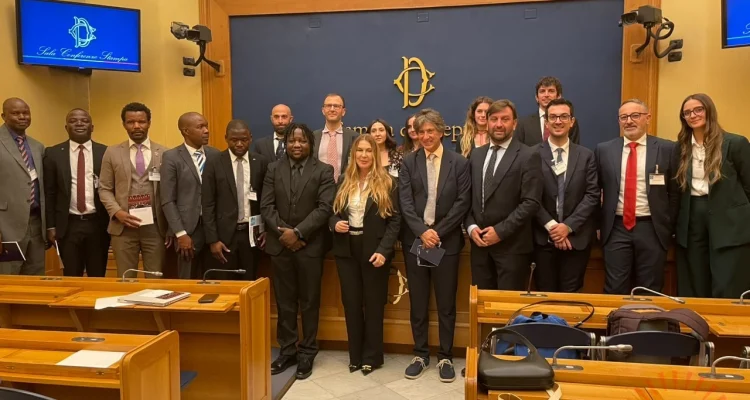
Blantyre Water Board (BWB) is seeking Italian expertise to improve water supply and management as it looks for ways to deliver more reliable services to consumers in the commercial capital.
The board has sent a seven-member delegation to Italy for a week-long study tour running from October 25 to 31, 2026, aimed at learning how established water utilities manage infrastructure, maintain water quality and ensure reliable services.
Led by BWB chairperson Stanley Chirwa, the delegation is undertaking the programme under the World Bank-financed Malawi Water and Sanitation Project-1 (MWSP-1).
Organised by Italian consultancy firm Ambiente S.r.l., the tour will expose the delegation to practical approaches in water supply management, infrastructure maintenance, corporate governance and institutional accountability.
One of the major objectives is to help BWB establish a Total Quality Management System (TQMS) and work towards obtaining relevant International Organization for Standardization (ISO) certification.
Chirwa said the programme would expose the board and management to international best practices that could be adapted to improve institutional performance and services to consumers.
The delegation is also examining ways of separating responsibilities between the board and executive management, strengthening oversight and improving strategic decision-making.
The study tour began in Rome, where the Malawian delegation engaged stakeholders from Italy’s Ministry of Foreign Affairs, the consultancy firm and Parliament’s Chamber of Deputies to discuss water governance and institutional arrangements.
The programme includes training on ISO 9001:2026, water resource management and quality assurance systems, alongside visits to water utilities and treatment facilities in Florence, Prato and Milan.
In Florence, the delegation is expected to visit Publiacqua, which provides integrated water services to about 1.3 million people across 46 municipalities. It will also tour the Anconella Drinking Water Treatment Plant, which supplies approximately 600,000 residents.
In Prato, the team will visit GIDA, a wastewater utility operating five treatment plants. Its Baciacavallo facility has a treatment capacity equivalent to wastewater generated by about 900,000 people, while its 70-kilometre industrial aqueduct supplies reclaimed water to the textile industry.
The Milan leg will focus on digital transformation, operational management and laboratory monitoring through engagements with Gruppo CAP and MM S.p.A., two institutions involved in managing water and wastewater services.
The delegation is expected to study real-time monitoring systems, infrastructure maintenance, water distribution networks, laboratory testing and quality assurance.
The lessons are expected to inform BWB’s efforts to improve maintenance planning, reduce service disruptions, strengthen water quality controls and ensure the long-term sustainability of its infrastructure.
The programme will conclude in Milan on October 31, with the delegation expected to review its findings and identify areas for future cooperation.
However, the real test will be whether BWB can translate the lessons from Italian water utilities into practical reforms that improve water supply and service delivery for consumers in Blantyre.