
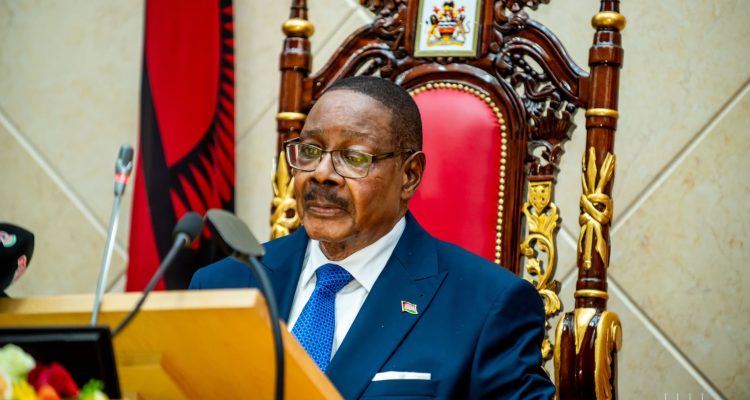
President Peter Mutharika on Friday told Parliament that his administration has moved swiftly to confront Malawi’s mounting economic challenges, declaring that decisive reforms introduced within four months of taking office are already laying the groundwork for financial stability and renewed growth in the country, something that the previous regime could not manage to do in five years.
The President made the remarks while delivering his State of the Nation Address (SONA) at the opening of the 2nd Meeting of the 52nd Session of Parliament in Lilongwe.
He said his government inherited an economy characterised by high inflation, food shortages, fuel scarcity, foreign exchange challenges, and declining public services.
“What we delivered in four months, some failed in five years,” President Mutharika told lawmakers.
The President said inflation, which stood at 28.7 percent in September 2025, is projected to decline to below 21 percent in 2026.
He said economic growth is projected to increase from 2.7 percent to 3.8 percent in 2026 and to 4.9 percent in 2027.
The President reported that prices of some basic commodities, including maize and cement, have gone down, while foreign exchange reserves remain below the recommended three months’ import cover.
To preserve public resources, he said the government has implemented austerity measures, including reducing fuel entitlements for Cabinet ministers and senior officials and restricting local and international travel.
President Mutharika announced that the government has increased the Constituency Development Fund from MK220 million to MK5 billion per constituency per year.
He said management responsibility for CDF resources has been shifted to controlling officers in local authorities and that the government has developed CDF guidelines to govern the use of the funds.
The President also announced that the government will invest in a national digital CDF dashboard to give Malawians real-time access to information on CDF utilisation.
He warned that those found mismanaging public resources would face the law.