

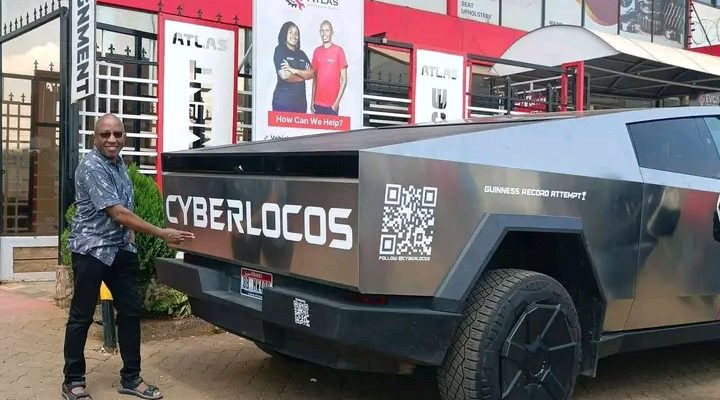
The arrival of the Tesla Cybertruck in Malawi drew crowds like a celebrity, Gwamba hitting the stage at a music concert.
In Lilongwe and at the Songwe border, people stopped to take selfies, record videos, and simply stare at the futuristic vehicle.
Social media quickly filled with posts and videos of the unusual sight. For many Malawians, it was not just a car; it was a rare glimpse of the future arriving in slow motion.
Popular social media page Akometsi shared a video of the vehicle entering the Songwe border with a Chichewa caption that read:
“Chithuchi chateladi, apa chinali chikulowa pa Songwe Border. M’chandani ichi?”
This roughly translates as follows: “Indeed, the Cybertruck has arrived. This is when it was entering Songwe Border, but who actually owns it?”
The post captured the national mood of amazement and curiosity. Across social media, users shared videos, memes, and selfies, celebrating the unusual sight and marvelling at the futuristic vehicle.
Adding context, Mikozi shared images of the Cybertruck while highlighting a tour announced earlier in the year.
Kenyan engineer Michael launched the Tesla Cybertruck Cyberlocos Tour in early January, showcasing the electric vehicle traveling, charging, and using renewable energy across Africa as part of a global expedition visiting multiple countries in an EV.
Unlike most everyday vehicles in Malawi, this one was tied to a broader narrative. It was a vehicle journeying across the continent to highlight electric mobility and sustainable transport.
Yet for Malawians, the combination of rarity, spectacle, and cutting-edge design made it feel historic.
Beyond the laughs and selfies lies a serious reflection on Malawi’s pace of technological adoption. While a Cybertruck might barely make headlines elsewhere, here it drew crowds.
This is not ignorance; it reflects how modern transport technologies remain rare and expensive locally, even as interest grows.
Electric vehicles are still emerging in Malawi. The market is small compared with other countries, and while EVs have been introduced commercially, they are not yet widespread.
Local companies, including renewable energy firms, have begun supplying electric cars, and institutions such as FDH Bank have adopted them, marking early steps toward cleaner transport.
The government has taken steps to encourage e-mobility. In the 2024/2025 budget, the state removed import duties and taxes on electric motorcycles and EV charging station materials to boost investment and reduce costs.
It also secured funding for feasibility studies and pilot charging points from international partners, including the World Bank.
Malawi’s EV charging network is still developing. At least three public EV charging stations have been established, with the regulatory body working on a framework to expand infrastructure and improve safety standards.
These developments point to gradual progress rather than instant adoption. The contrast between global trends and local reality helps explain why one vehicle can feel like a national event. Advanced technologies are beginning to enter the market, but wider adoption and the systems that support it are still evolving.
The public reaction should not be dismissed as backwardness. It shows curiosity, openness to innovation, and eagerness to engage with modern technology. Humor allows Malawians to celebrate progress while acknowledging gaps in access and infrastructure.
Moments like this are also a mirror. They raise important questions. Are we creating conditions that attract innovation early? Are we preparing infrastructure ahead of technological waves? Are we encouraging local adaptation rather than mere admiration?
The lesson is clear. Awareness precedes adoption. Malawians are ready to witness and participate in global innovation, but the challenge is ensuring that infrastructure, policy, and investment keep pace.
If harnessed correctly, curiosity can drive demand, inspire local entrepreneurship, and accelerate technology adoption in the country.
Perhaps the most telling reflection comes from the spectacle itself. A single futuristic vehicle can stop a nation in its tracks. Yet it also reminds us that progress does not always arrive evenly. Sometimes, we are still “loading” while the rest of the world moves forward.
For now, the national progress bar may still be buffering.