

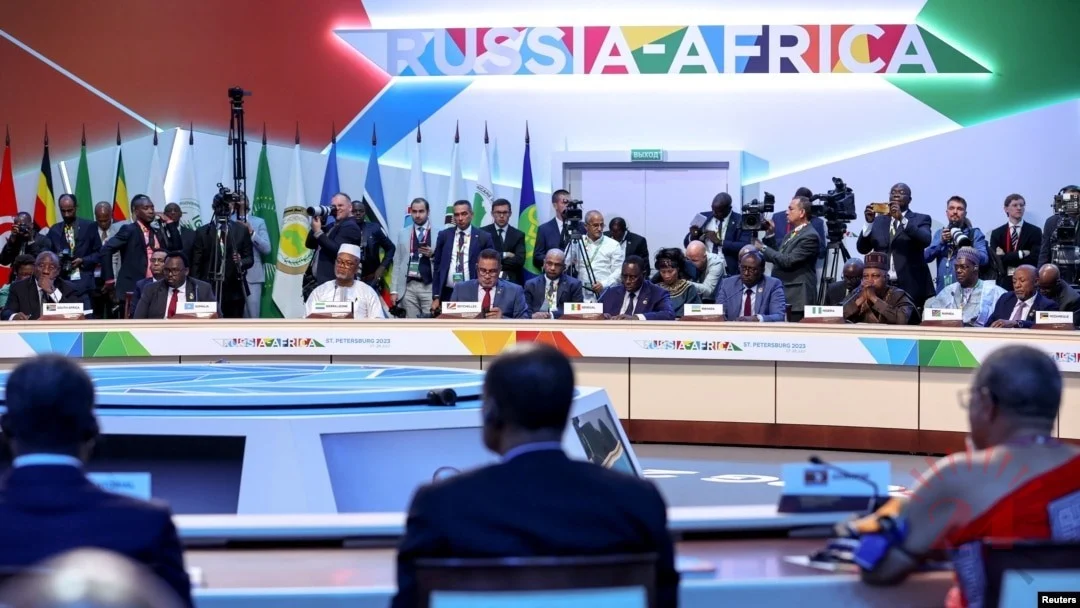
Malawi’s failure to send a presidential-level delegation to the third Russia-Africa Summit has raised questions over the country’s diplomatic priorities and its response to the recruitment of young Africans into Russia’s war against Ukraine.
Political and human rights campaigners have criticised the government’s absence from the October 28–29 summit, arguing that Malawi missed an opportunity to press Moscow over deceptive recruitment schemes targeting African youths.
Authorities have justified the decision by pointing to President Peter Mutharika’s private visit to South Africa. However, campaigners argue that a cabinet minister could have represented Malawi at the high-level meeting.
Although Malawi was absent from the list of attending heads of state, it was officially listed among delegations from 48 African countries. Only 22 African presidents attended this year’s summit, down from 43 at the inaugural 2019 meeting.
Among the leaders present were Zimbabwe’s Emmerson Mnangagwa, Ghana’s John Dramani Mahama, Mali’s Assimi Goïta, South Sudan’s Salva Kiir, Mozambique’s Daniel Chapo, Equatorial Guinea’s Teodoro Obiang Nguema Mbasogo, Eritrea’s Isaias Afwerki and Republic of the Congo’s Denis Sassou Nguesso. Other countries, including Uganda, Rwanda, Algeria, Burkina Faso and South Africa, sent senior government representatives.
The summit ended with several trade and business memoranda of understanding, while Russian President Vladimir Putin pledged to support Africa’s self-sufficiency and double trade with the continent by 2030.
Before the meeting, Malawi’s Ministry of Foreign Affairs told the media that the country would not send a delegation but did not provide an official explanation. The decision came against the backdrop of Mutharika’s earlier restrictions on non-essential domestic and international travel as part of austerity measures aimed at addressing the country’s economic challenges.
At the 2025 summit, Malawi was represented by Foreign Affairs Minister George Chaponda, who later told the media that deceptive youth recruitment had not featured in his engagements. His remarks came amid calls from political commentators for Malawi to pursue trade opportunities while also confronting Russian authorities over the recruitment of young Africans.
China-based Malawian political scholar Jani Gray Kasunda said Malawi should have used the latest summit to raise the issue, particularly as youth unemployment continues to expose young Africans to fraudulent overseas job opportunities.
Concerns intensified in November 2025 after reports emerged that young Malawian women were among hundreds of Africans trapped in Alabuga, a Russian military-industrial zone involved in producing combat drones for the war in Ukraine.
“While we understand President Mutharika was on a private visit to South Africa, a cabinet minister should have represented the country,” Kasunda said. “Deceptive job recruitment and fake educational offers cannot be tolerated in this modern age, and we need clear answers on what the government is doing.”
Kasunda also pointed to Ghana’s engagement with Russia, arguing that African countries should use international platforms to demand an end to the recruitment of their citizens into the war.
“Look at what Ghana achieved during the summit regarding deceptive job offers. African countries must pile pressure on Russia to stop recruiting African youths to fight in this war,” he said.
Malawi’s concerns over the recruitment schemes have already been raised at government level. In August 2026, Homeland Security Minister Peter Mukhito expressed alarm over fraudulent employment and educational offers after four Malawian youths became trapped in Russian war-related industries through Alabuga Special Economic Zone (SEZ) scholarship arrangements.
Ghana, meanwhile, secured a commitment from Moscow following a bilateral meeting between President Mahama and Putin. Accra announced that Russia had agreed to stop recruiting Ghanaian nationals through the Alabuga SEZ, whether through formal recruitment or voluntary enlistment.
The Alabuga Start programme primarily targets young women aged between 18 and 22 through social media advertisements promising work-study opportunities in hospitality, catering and floristry. The offers reportedly include free air tickets, accommodation and competitive salaries.
The consequences of such recruitment schemes have extended beyond Malawi. Zambian national Lemekhani Nyirenda, 23, and Tanzanian Nemes Tarimo, 37, were imprisoned in Russia over drug-related offences before reportedly being offered freedom in exchange for joining the Wagner mercenary group. Both later died fighting in Ukraine.
National Advocacy Platform (NAP) chairperson Benedicto Kondowe said Malawi needed direct engagement with Moscow to prevent further recruitment and secure the return of citizens caught up in the conflict.
“It is vital to agree on practical measures to curb this vice, prevent future occurrences, and implement a plan to safely return all African youths trapped in the war zone to their home countries,” Kondowe said.
International scrutiny of the Alabuga programme has also increased. The US State Department’s 2026 Trafficking in Persons Report, released in October, raised serious human trafficking concerns linked to Alabuga Start.
A May 2025 investigation by the Global Initiative Against Transnational Organized Crime (GI-TOC) also concluded that aspects of the programme, particularly deceptive recruitment and restrictive labour conditions, met the legal definitions of human trafficking.
In January 2026, Russian authorities reportedly introduced a recruitment stop-list directing military officials to halt enlistments from 36 countries across Africa, the Middle East, Asia and South America.
However, analysts have questioned the effectiveness of the restrictions. Between January and September 2026, 1,449 Colombian nationals and 259 Indians reportedly signed contracts with the Russian military despite their countries being on the list, largely through black-market recruitment agencies.
Malawi maintains diplomatic relations with both Moscow and Kyiv, but campaigners argue that diplomatic neutrality should not prevent the government from taking steps to protect its young citizens.
Two months ago, Lilongwe formally acknowledged the existence of fraudulent online job and scholarship offers, saying government agencies and other stakeholders were conducting nationwide civic awareness campaigns to warn the public about the schemes.
Reported by Kingsley Shema