

For decades, charcoal has been the fuel of choice for most urban and peri-urban households, a convenience that has come at a heavy cost to the environment. But communities in areas under Traditional Authority Kapeni in Blantyre, are beginning to question whether the way they cook today is silently stealing from their tomorrow.

At the heart of this transformation is the Centre for Environmental Policy and Advocacy (CEPA), which is implementing the Promoting Equitable Access to Clean Energy (PEACE) project, funded by the European Union and implemented in partnership with Oxfam and the Civil Society Network on Climate Change (CISONECC).
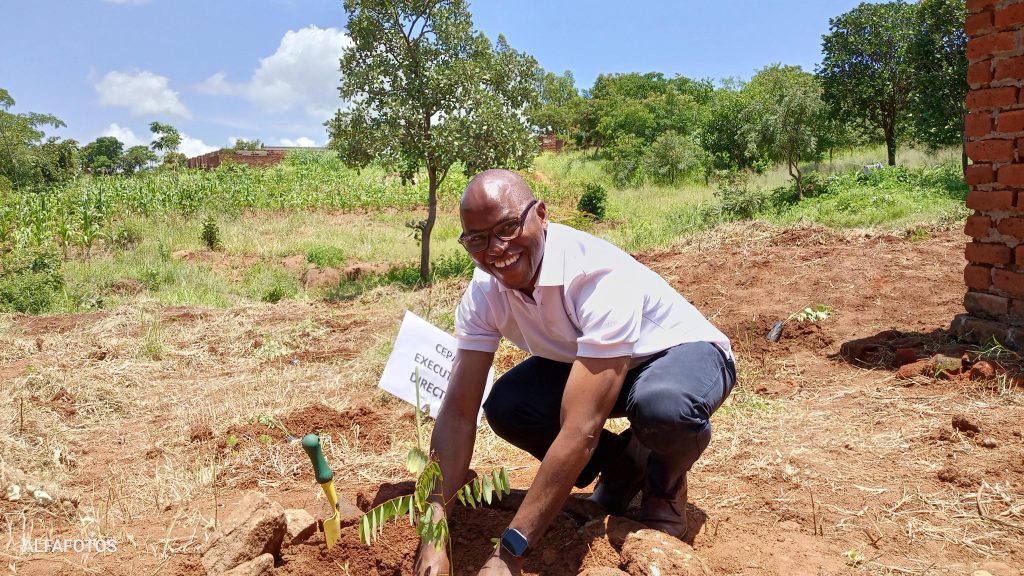
Leading by example: Mwalukomo
Mwalukomo explained that Malawi remains heavily dependent on biomass energy, with over 80 percent of households relying on firewood and charcoal. While this reality cannot be ignored, he said it must be managed in a way that protects forests and livelihoods.
“Unsustainable charcoal is one of the biggest drivers of deforestation, largely because of high demand in urban areas,” he said. “That is why we are promoting alternatives, not to punish people, but to safeguard the environment we all depend on.”
Through the PEACE project, CEPA has promoted a mix of clean and efficient cooking solutions. To date, 476 households in TA Kapeni have been reached with clean cooking technologies, including LPG stoves, Smarthome cooking stoves, chitetezo mbaula, electric hotplates and induction stoves.
These technologies are designed to reduce firewood consumption, cut household costs over time, and lessen pressure on surrounding forests.

Shifting to sustainable cooking-Communities in T/A Kapeni
For community members like Agnes Thomas, the shift has been both practical and deeply personal. She described the clean cooking technologies as an ideal balance between daily household needs and environmental protection.
“We have welcomed these clean energy solutions because they are helping us protect our environment,” Thomas said. “When you use these stoves, you don’t need to cut many trees, and that means our forests can recover.”
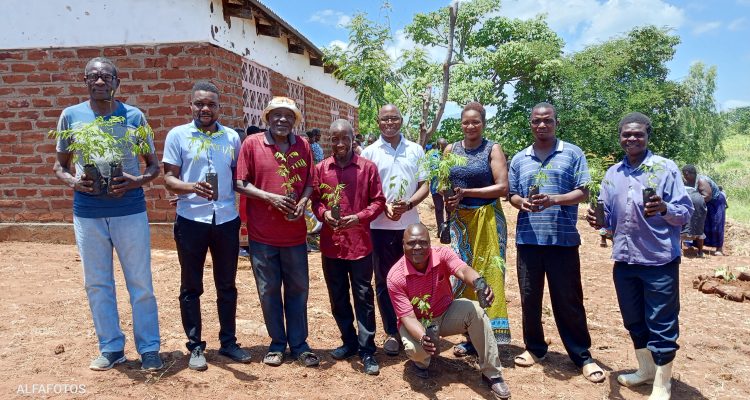
Alongside promoting clean cooking, CEPA has made tree planting a core pillar of the project. Last week, the organisation planted 250 trees in a newly established community woodlot under Group Village Head Loben Nsambuzi, and a further 214 trees in another community woodlot in the area of Senior Group Village Head Maness Kapeni.
Beyond the day’s exercise, the scale of the effort is already visible across Lunzu. This year alone, CEPA has planted about 21,214 trees across five villages, in both individual and community woodlots, a move aimed at restoring degraded land while creating long-term sources of sustainable wood.
Mwalukomo also challenged the widespread belief that modern cooking methods are beyond the reach of ordinary households.
“Many people buy charcoal every day,” he said. “When you calculate that cost at the end of the month and compare it with electricity or gas, the difference is not as big as people think. In some cases, studies have shown that electricity can even be cheaper.”
Beyond household budgets, he said, lies a deeper cost that Malawians can no longer afford to ignore. “The environmental cost should worry us all,” Mwalukomo said. “Deforestation, land degradation, floods and droughts are realities we experience year in, year out.”
Changing behavior, however, has not been without challenges. Resistance, he said, is often rooted in mindset and long-standing habits.

Communities taking the responsibility
“When you are used to doing things a certain way, change takes time,” he said. “Some people believe certain foods can only be cooked using charcoal, which is simply not true.”
Still, progress is visible on the ground. Some households have adopted improved cookstoves without subsidies, while others have installed biogas systems after recognising the long-term benefits. Trees planted in earlier phases of the project are still standing, with high survival rates attributed to strong community ownership.
As the project approaches its scheduled phase-out around June 2026, some community members have expressed concern about what will happen next. Mwalukomo insists sustainability was embedded from the start.
“A project must have an end date, but behaviour change should not,” he said. “The stoves will not be thrown away, and the trees will not be uprooted because CEPA is leaving.”
Blantyre District Council has committed to sustaining the gains made. Forestry Officer Noel Moyo said the council will continue working through Village Natural Resource Management Committees, established government structures responsible for protecting natural resources at community level.
“These committees will take over the responsibility of encouraging communities to manage and protect the planted trees,” Moyo said.

Moyo: Let everyone plant a tree and take care of it
He said last season’s tree survival rate stood at about 75 percent, with renewed efforts underway to improve it further by encouraging school learners and community members to adopt individual trees, particularly in degraded areas, riparian zones and bare land.
At the traditional leadership level, Senior Group Village Head Maness Kapeni has taken a firm stance. He has introduced and pledged to enforce bylaws requiring every community member to participate in tree planting and tree care.
“Everyone must plant a tree,” GVH Kapeni said. “And everyone must take responsibility for looking after it.”