

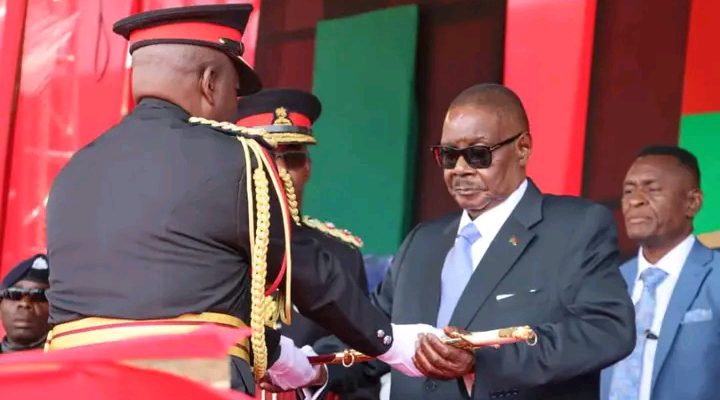
By Praise Kambilonje
Four months after Malawians headed to the polls on September 16, 2025, governance experts say the country’s peaceful transition of power—echoing the 2020 handover—is a sign of a maturing democratic culture.
According to various commentators, the 2025 presidential election serves as a regional model.
Former President Peter Mutharika secured 57% of the vote, while incumbent Lazarus Chakwera conceded, preventing the outbreak of political violence.
This stands in sharp contrast to several SADC neighbors where electoral disputes have led to protests or irregularities. While Botswana remains a positive outlier, other nations in the region continue to face significant democratic hurdles.
“SADC elections often face hurdles like dominant party interference and deep-seated mistrust, yet Malawi and Botswana demonstrate viable democratic maturation through voluntary concessions,” says human rights and governance campaigner Christopher Kambwiri.
Kambwiri notes that while Mozambique and Tanzania struggle with allegations that erode public trust and prompt international criticism, and Zimbabwe remains bogged down by unresolved disputes, Malawi has shown a capacity for continuity without major fallout.
The road to 2025Malawi held its general elections on September 16, 2025, following its standard five-year constitutional cycle.This followed the 2020 court-mandated fresh presidential election that originally brought Lazarus Chakwera to power.
The 2025 polls, which covered the presidency, National Assembly, and local government, took place against a backdrop of economic hardship, including high inflation and chronic shortages of fuel, forex, and food.
Benedicto Kondowe, head of the National Advocacy Platform (NAP)—a coalition of civil society organizations—told this publication that Malawi’s political history shows a growing acceptance that power is derived from the people.
“Leaders conceding defeat, respecting court outcomes, and handing over authority without widespread violence has helped entrench the norm that elections are a contest, not a war. This is a significant democratic gain that should not be understated,” Kondowe says.
However, he argues that a peaceful concession is not the ultimate test of democracy. Kondowe warns: “We still see challenges regarding campaign fairness, the abuse of incumbency, electoral disputes, and subtle attempts to weaken institutions when outcomes are unfavorable.”
According to Kondowe, true democratic consolidation requires more than just accepting a loss; it requires a consistent respect for the rule of law and the rights of citizens before, during, and after the polls.
Learning the mechanics of transition
Governance expert Augustine Magolowondo agrees that while the strides are positive, the technical process of transitioning power remains a “work in progress.”

“Transition of power is an area where the country is still learning,” Magolowondo says. “We saw the semblance of a joint transition team between the outgoing and incoming administrations, but it quickly vanished.
“The gaps became particularly evident when, following last-minute developments, President Chakwera did not attend the swearing-in ceremony of the incoming president.”
Magolowondo observed that although the signs of a Mutharika victory were clear early on, the Chakwera administration appeared to struggle with the reality of the result.
“A big lesson for those participating in elections is that they must prepare not just to win, but also to lose. They must have a plan in case things do not go their way.
“This was likely what was missing for the Malawi Congress Party and President Chakwera. Losing did not seem to be within their imagination, leaving them in a state of shock,” Magolowondo explains.
He emphasizes that for future transitions to be managed effectively, political players must develop greater trust in critical institutions such as the Office of the President and Cabinet (OPC), State House, and security agencies.
Constitutional routine
Malawi’s Constitution mandates general elections every five years on the third Tuesday of September. Although the 2019 results were nullified, the 2020 election reset the clock, aligning the 2025 vote precisely with routine democratic timing.
Despite the economic stagnation that fueled a high voter turnout of approximately 76%—viewed by many as a referendum on governance—the Malawi Electoral Commission (MEC) managed the process to its conclusion, declaring Mutharika the winner and enabling a peaceful, if imperfect, handover of power.