

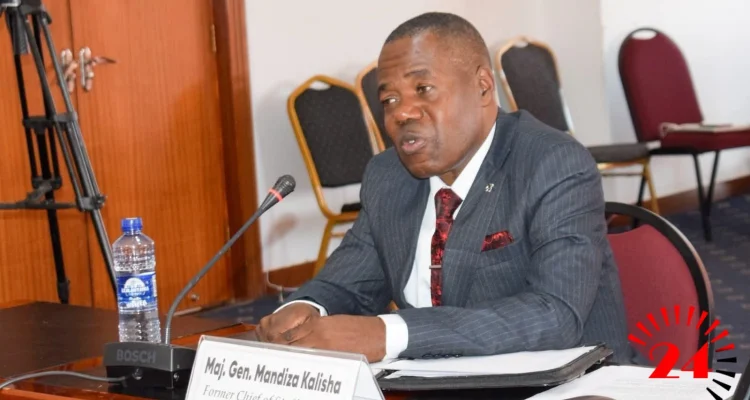
Former Malawi Defence Force (MDF) Chief of Staff Major General Mandiza Kalisha has told Parliament’s Ad-hoc Committee investigating the Chikangawa military plane crash that killed former Vice-President Saulos Chilima and eight others that the pilots aboard the ill-fated aircraft were operating with expired licences after the Malawi Air Force failed to conduct mandatory refresher training due to funding constraints.
Appearing before the committee, Kalisha said persistent financial challenges had crippled refresher training programmes for pilots, resulting in the non-renewal of their licences.
Kalisha, however, distanced himself from the operational management of the aircraft, saying he only assumed office as Chief of Staff on May 13, 2024, less than a month before the June 10 crash.
“I had no prior involvement in any aircraft or flight operations,” he told the committee, adding that aircraft and flight operations did not fall under his responsibilities.
He further disclosed that when he took office, Malawi Air Force aircraft were not insured because they required maintenance. The aircraft remained uninsured throughout his tenure, which ended in October 2024.
Recounting the events of the day of the crash, Kalisha said he received a phone call from Malawi Air Force Commander Major General Robray Ismael informing him that the aircraft had gone missing. He then contacted Deputy Air Force Commander Major General Harrison Kandula at Zomba Air Base, who confirmed the development.
Kalisha said he was later summoned to a meeting by the then MDF Commander, General Paul Valentino Phiri, who told those present that he had instructed the Air Force Commander to have the aircraft return to Lilongwe immediately if communication was re-established. General Phiri also said he had briefed the President by telephone and that search and rescue operations had already been launched.
Kalisha maintained that his involvement in the incident was limited to receiving updates from the Malawi Air Force Commander and attending the meeting convened by the MDF Commander.
Appearing before the committee, Kalisha said persistent financial challenges had crippled refresher training programmes for pilots, resulting in the non-renewal of their licences.
Kalisha, however, distanced himself from the operational management of the aircraft, saying he only assumed office as Chief of Staff on May 13, 2024, less than a month before the June 10 crash.
“I had no prior involvement in any aircraft or flight operations,” he told the committee, adding that aircraft and flight operations did not fall under his responsibilities.
He further disclosed that when he took office, Malawi Air Force aircraft were not insured because they required maintenance. The aircraft remained uninsured throughout his tenure, which ended in October 2024.
Recounting the events of the day of the crash, Kalisha said he received a phone call from Malawi Air Force Commander Major General Robray Ismael informing him that the aircraft had gone missing. He then contacted Deputy Air Force Commander Major General Harrison Kandula at Zomba Air Base, who confirmed the development.
Kalisha said he was later summoned to a meeting by the then MDF Commander, General Paul Valentino Phiri, who told those present that he had instructed the Air Force Commander to have the aircraft return to Lilongwe immediately if communication was re-established. General Phiri also said he had briefed the President by telephone and that search and rescue operations had already been launched.
Kalisha maintained that his involvement in the incident was limited to receiving updates from the Malawi Air Force Commander and attending the meeting convened by the MDF Commander.