

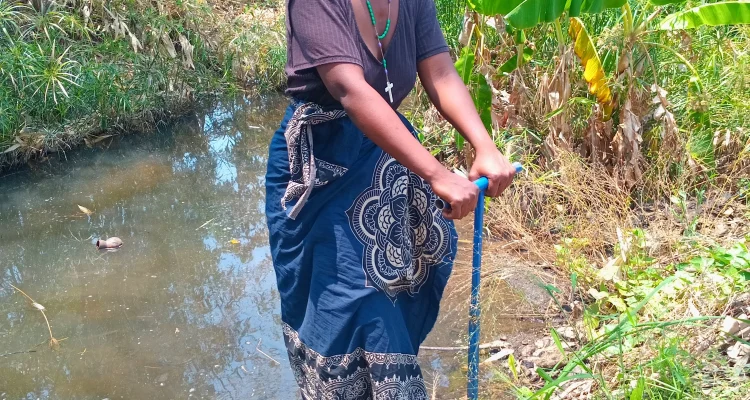
It is a bitter contradiction: rural farmers are encouraged to embrace irrigation farming to improve food production and household nutrition, yet some are struggling to access even the basic equipment that could make their efforts easier.
In Salima District, members of Kasupe Care Group have taken the call to heart. They have organised themselves, planted different crops, learned to make their own manure and continued working together for years. But when it comes to their communal garden, they still lack a water pump, leaving them to depend on the nearby Kasupe stream to irrigate their crops.
There is something deeply troubling about asking poor communities to change their farming practices, become self-reliant and improve their nutrition without paying sufficient attention to the practical barriers they face. It is easy to tell people to embrace irrigation farming. It is much harder to explain why a group that is already working towards that goal cannot access a basic tool that could make the work less demanding.
The irony is that these farmers are not asking someone to cultivate their land for them. They are not waiting for food handouts. They are already doing the work. They grow maize, beans and vegetables, prepare manure from locally available materials and pool resources to buy additional farm inputs. They have demonstrated initiative and commitment. Yet, for their communal garden, the absence of a pump remains a significant challenge.
For a country and development partners concerned about food security and nutrition, this should be more than a passing concern. Encouraging irrigation farming while overlooking the equipment needs of communities willing to practise it risks turning well-intentioned messages into empty promises. It is, at the very least, a failure to connect advice with the practical support needed to put it into action.

Mikayere Benedicto, a member of Kasupe Care Group from Kachilele, says joining the group has improved access to vegetables in his household. Members have adopted crop rotation, alternating crops such as maize and groundnuts, while using groundnut leaves, maize stalks and ash to prepare manure.
“Before we started, we struggled to access vegetables. Since joining the group, vegetables have become more readily available, providing our bodies with vitamins. We have also noticed that children and adults are not falling sick as frequently as before,” said Benedicto.
He says the group has grown from fewer than 30 members to more than 40. Its experience shows what collective effort and shared knowledge can achieve, even when resources are limited. But growth should also prompt an uncomfortable question: how much more could these farmers accomplish if the practical needs they identify were taken seriously?
The challenge becomes clearer when compared with the experience of Maureen Thomas, another Kasupe Care Group member and household beneficiary from Mkhute Village under Traditional Authority Kambwiri. She grows maize, tomatoes, okra, mustard greens and Chinese cabbage in her individual garden, where she uses a pump to water her crops.
Thomas says gardening has helped her household access a wider variety of foods and earn money from surplus produce. Before she started, she struggled to access vegetables and maize, as well as generate income from selling farm produce. She also reported that her children used to fall sick frequently, a situation she says has improved as their diet has become more varied.
However, while Thomas has a pump for her own garden, the communal garden managed by Kasupe Care Group does not have one. The group relies on water from the Kasupe stream, but the absence of a pump makes irrigation more demanding.
The contrast is revealing. Thomas’s experience illustrates the role a pump can play in supporting an individual farmer’s work, while the communal garden’s situation shows how a lack of equipment can constrain a collective initiative. A pump alone will not solve every challenge, but it could help ease the burden of watering crops and allow members to use their time and labour more efficiently, provided the equipment is suitable and water is available.

Lucy Esau, who oversees nutrition activities for Tiyanjane, Kasupe and Nsaopera care groups, says members have continued applying the knowledge they acquired through earlier support, even after organisations that initially assisted them withdrew.
The groups have maintained communal farming activities, producing crops for household consumption and selling surplus produce within their communities. At Kasupe, members also make manure locally and pool resources to purchase other farm inputs.
Their determination is commendable. But resilience should not become a convenient excuse for institutions to leave communities to fend for themselves. A group that has managed to survive with limited resources is not a group that has no need for support. In fact, its commitment to continuing the work should make its needs more worthy of attention, not less.
Daudi Mkanya, an agricultural extension worker from Katelera Extension Planning Area in Salima, says irrigation farming is becoming increasingly important as rainfall-dependent agriculture grows less reliable. He encourages farmers to use available water sources, including rivers and streams, to produce food beyond the rainy season.
However, Mkanya also identifies limited access to irrigation equipment and competition for water as challenges affecting farmers. His observations highlight the distance between encouraging irrigation farming and ensuring that communities have the means to practise it effectively.
The Ulimi ndi Chilengedwe (UCHI) Joint Programme, funded by the European Union under the Global Gateway, seeks to contribute to sustainable and inclusive economic growth through resilient food systems and improved well-being. Its nutrition component, implemented by UNICEF in partnership with the Government of Malawi, promotes the production and consumption of diverse, nutritious foods, alongside improved food processing, preparation and nutrition practices.
These objectives are important, particularly in communities where households are working to improve their access to food. But the experience of Kasupe Care Group raises a legitimate question about whether the practical needs of participating communities are receiving sufficient attention. Training and encouragement matter, but they cannot substitute for addressing the barriers farmers themselves identify.
It would be unfair to suggest that government departments or development partners must provide every farmer with every tool they request. Resources are limited, and irrigation equipment requires proper management, maintenance and arrangements for sharing. Nevertheless, where an organised group has demonstrated commitment and identified a specific obstacle to its work, there should be a serious assessment of what support is feasible and who is responsible for providing it.
Otherwise, the message to rural communities becomes deeply frustrating: work harder, produce more, diversify your food and become self-reliant, but find your own way when the basic equipment needed to make the work easier is beyond your reach.
For Kasupe Care Group, the request is straightforward. Members want a pump for their communal garden. They are prepared to continue doing the farming themselves; they need help with one of the practical challenges standing in their way.
There is something almost laughable about celebrating the language of self-reliance while overlooking the modest interventions that could help people achieve it. More importantly, it is disheartening for farmers who have responded to calls for change to find that their own effort does not necessarily translate into the support they need.
The real test of agricultural and nutrition programmes is not simply how many communities are told to grow more food, but whether those communities are able to overcome the obstacles that limit their progress. Kasupe Care Group has shown willingness, organisation and persistence. What remains to be seen is whether the institutions encouraging such efforts will respond to the practical realities on the ground.
These farmers do not need another lecture on the importance of irrigation farming. They need their concerns heard, their circumstances assessed and practical solutions pursued. If self-reliance is the goal, support should not stop at telling people what to do; it should also help them overcome the barriers that stand in their way.