

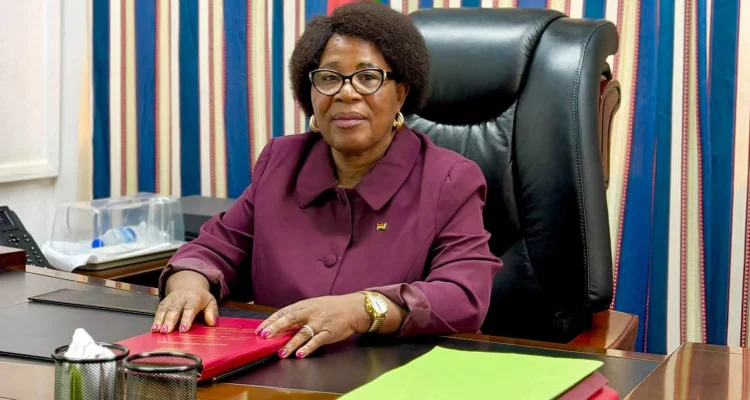
In the grand theatre of Malawian politics, the most powerful weapon Jane Ansah possesses right now is not a loud protest, but absolute, artistic quietude.
History is a loud teacher. If former Vice Presidents Cassim Chilumpha, Joyce Banda, and Saulos Chilima taught us anything, it is that when the presidency turns its back on you, your loudest defiance is your silence.
It is tempting to throw stones at the palace guards. Blaming figures like Justin Saidi for blocking communication lines to the President is a misplaced anger.
In political fortresses, gatekeepers rarely act on their own whims; they follow strict scripts written by the man at the top. If the gates are closed, it is because President Mutharika ordered them shut.
Ansah has two logical choices: confront the mastermind directly, or take the quiet, comfortable route. In fact, collecting a free state salary while redirecting precious energy toward private business investments is a victory in its own right.
What remains of a cordial relationship when two leaders cannot exchange a simple phone call, text message, or email? When the digital and personal lines are entirely severed, the partnership is not just fractured—it is dead.
Truth be told, political alliances or relationships are inherently conditional, fluid, and fragile. A running mate ticket is not a sacred vow; even the most passionate couples divorce when the season changes.
Ansah must remember the haunting lesson from Chinua Achebe’s Things Fall Apart. Young Ikemefuna looked at Okonkwo as a father, crying out to him for protection when the elders attacked. Yet, to protect his own pride, it was Okonkwo himself who dealt the final, fatal blow.
In this political drama, Mutharika holds the blade. Trusting past promises in a shifting political landscape is a fatal error. This is a free advice to Jane Ansah.
This friction is deeply rooted in the constitutional architecture of the state. Until the supreme law of the land is amended to give clear, legally defined executive duties to the Vice President, anyone sitting in that seat will always be viewed as an existential threat to the President.
Compounding this structural flaw is the reality of time and health. With Mutharika’s advanced age and frequent medical trips to South Africa, the vacuum of power has widened.
A paranoid inner circle of corrupt associates now guards the ailing leader. They are terrified that a clean, sharp figure like Jane Ansah will disrupt their financial feeding troughs if she gets too close to the seat of power.
Fortunately, this situation is solvable. What other options can Jane Ansah take?
First, as a matter of emphasis, she must stop knocking on doors that have been deliberately locked from the inside. She should protect her dignity by retreating into a strategic silence.
As noted before, she should collect her legally entitled benefits and channel her energy, time, and intellect into her private business investments. Let the state payroll fund her next chapter.
As the president in waiting according to the supreme Malawi Constitution, she should be alert and hopeful while keeping accurate, private records of her tenure. When the political tides turn, her side of history will be her shield. Joyce Banda is a living precedent in this case.
However, should President Mutharika just leisurely watch this episode of his own making?
President Peter Mutharika has the responsibility to clarify the hierarchy. If the partnership is truly over, communicate the boundaries formally rather than using palace staff as shields.
As a precedent, former president Chakwera explicitly told the nation that he had stopped delegating duties to his vice Saulos Chilima when he was arrested on corruption charges. Perhaps President Mutharika has no substantial basis for sidelining Jane Ansah.
Furthermore, with his health requiring international travel, Mutharika must formalise temporary power structures so the nation does not fall into the hands of unelected, paranoid cabals.
Most importantly, Mutharika has an obligation to protect his legacy; he should not let the twilight of his presidency be defined by internal warfare. A orderly transition of respect yields a far better historical legacy than this internal ugly palace coup.
History is a loud teacher. If former Vice Presidents Cassim Chilumpha, Joyce Banda, and Saulos Chilima taught us anything, it is that when the presidency turns its back on you, your loudest defiance is your silence.
It is tempting to throw stones at the palace guards. Blaming figures like Justin Saidi for blocking communication lines to the President is a misplaced anger.
In political fortresses, gatekeepers rarely act on their own whims; they follow strict scripts written by the man at the top. If the gates are closed, it is because President Mutharika ordered them shut.
Ansah has two logical choices: confront the mastermind directly, or take the quiet, comfortable route. In fact, collecting a free state salary while redirecting precious energy toward private business investments is a victory in its own right.
What remains of a cordial relationship when two leaders cannot exchange a simple phone call, text message, or email? When the digital and personal lines are entirely severed, the partnership is not just fractured—it is dead.
Truth be told, political alliances or relationships are inherently conditional, fluid, and fragile. A running mate ticket is not a sacred vow; even the most passionate couples divorce when the season changes.
Ansah must remember the haunting lesson from Chinua Achebe’s Things Fall Apart. Young Ikemefuna looked at Okonkwo as a father, crying out to him for protection when the elders attacked. Yet, to protect his own pride, it was Okonkwo himself who dealt the final, fatal blow.
In this political drama, Mutharika holds the blade. Trusting past promises in a shifting political landscape is a fatal error. This is a free advice to Jane Ansah.
This friction is deeply rooted in the constitutional architecture of the state. Until the supreme law of the land is amended to give clear, legally defined executive duties to the Vice President, anyone sitting in that seat will always be viewed as an existential threat to the President.
Compounding this structural flaw is the reality of time and health. With Mutharika’s advanced age and frequent medical trips to South Africa, the vacuum of power has widened.
A paranoid inner circle of corrupt associates now guards the ailing leader. They are terrified that a clean, sharp figure like Jane Ansah will disrupt their financial feeding troughs if she gets too close to the seat of power.
Fortunately, this situation is solvable. What other options can Jane Ansah take?
First, as a matter of emphasis, she must stop knocking on doors that have been deliberately locked from the inside. She should protect her dignity by retreating into a strategic silence.
As noted before, she should collect her legally entitled benefits and channel her energy, time, and intellect into her private business investments. Let the state payroll fund her next chapter.
As the president in waiting according to the supreme Malawi Constitution, she should be alert and hopeful while keeping accurate, private records of her tenure. When the political tides turn, her side of history will be her shield. Joyce Banda is a living precedent in this case.
However, should President Mutharika just leisurely watch this episode of his own making?
President Peter Mutharika has the responsibility to clarify the hierarchy. If the partnership is truly over, communicate the boundaries formally rather than using palace staff as shields.
As a precedent, former president Chakwera explicitly told the nation that he had stopped delegating duties to his vice Saulos Chilima when he was arrested on corruption charges. Perhaps President Mutharika has no substantial basis for sidelining Jane Ansah.
Furthermore, with his health requiring international travel, Mutharika must formalise temporary power structures so the nation does not fall into the hands of unelected, paranoid cabals.
Most importantly, Mutharika has an obligation to protect his legacy; he should not let the twilight of his presidency be defined by internal warfare. A orderly transition of respect yields a far better historical legacy than this internal ugly palace coup.