
Kaphwiti family camps at Tichitenji Estate as legal battle enters another chapter
By Sarah Saulos
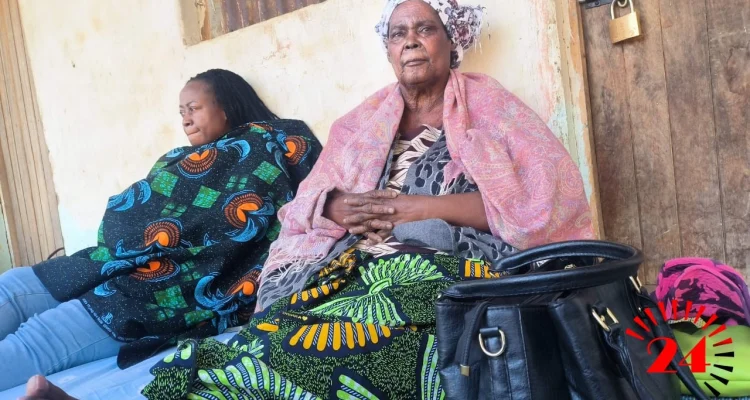
As the cold Mchinji night descended over Tichitenji Estate on Wednesday night, 75-year-old Falesi Kaphwiti Banda wrapped herself against the chill and prepared to spend another night on the land she says her family has been fighting to reclaim for more than three decades.
For her, the makeshift camp on the disputed 583.7-acre estate is not just a protest. It is a final plea for justice.
The widow of the late Elias Kaphwiti Banda has returned to the property with members of her family, vowing to remain there until the courts provide direction on a stay order that has prevented them from enforcing a High Court judgment declaring them the lawful owners of the land.
“We are not asking for special treatment. We are only asking for the justice that the court has already given us,” Falesi said, her voice carrying years of exhaustion, pain and frustration.
She says the family has endured decades of legal battles, financial hardship and emotional suffering while waiting to reclaim land they believe was taken from them during Malawi’s one-party era.
“I will stay here because this matter has taken too long,” she said. “Even if it means sleeping in the cold, I will stay until justice is done.”
The Tichitenji Estate dispute has been one of Malawi’s longest-running land battles, involving the family of Elias Kaphwiti Banda and Cecilia Tamanda Kadzamira, the former official hostess of founding president Hastings Kamuzu Banda.
The Kaphwiti family says Elias Kaphwiti Banda acquired a 99-year title deed for the estate in 1968, before the family fled to Zambia in September 1971.
According to Falesi, after their departure, their relatives who remained at the farm were evicted, and the land eventually came under the control of Kamuzu Banda, who later allegedly surrendered it to Kadzamira.Kadzamira has maintained that the former president gave her the property in 1972.
The dispute returned to the courts after Malawi’s transition to democracy, but the legal battle intensified in 2020 when Kadzamira obtained an order preventing the Kaphwiti family from accessing the estate, accusing them of trespassing.
The family challenged the decision, arguing that their original title deed remained valid and had never been legally cancelled or forfeited.
Their legal battle eventually reached High Court Judge Simeon Mdeza, who in December 2025 ruled in favour of the Kaphwiti family.
In his judgment, Justice Mdeza found that the Kaphwitis were the rightful owners because they had obtained their title deed earlier and there was no evidence that it had ever been lawfully surrendered.
“If the surrender never happened, the land never reverted to government,” Justice Mdeza ruled.
“No person can give what they do not have.”
The judge also questioned the validity of Kadzamira’s title documents, finding that they were registered years after execution and could not override the earlier title held by the Kaphwiti family.But the family’s victory was short-lived.
Three days after the judgment, a stay of execution was granted pending an appeal, effectively preventing the Kaphwitis from taking possession of the estate.
The family says the stay order has left them trapped in another cycle of uncertainty.
“This case has cost us money, peace and emotional well-being,” said Tapiwa Kaphwiti, one of Elias Kaphwiti Banda’s daughters. She said the dispute has consumed most of her life.
“I was born in exile 36 years ago when this dispute was already raging. Today my first-born daughter is going to university, but the matter is still unresolved,” Tapiwa said.
“All our income goes towards endless court processes. How long will we wait for justice?”
The family has appealed to the Judiciary and other relevant authorities to ensure the appeal process is concluded quickly.“We respect the courts, but this case has taken too long,” Tapiwa said.
“We are calling on everyone who can help to ensure justice is delivered.”
The family is also raising concerns about activities taking place on the estate while the matter remains before the courts.
Meanwhile, Traditional Authority Kawere has continued with the distribution of customary land associated with the disputed estate to local residents, adding another layer of complexity to the already contested property.
For Falesi, the dispute is about more than land. It is about restoring a family legacy and finding peace before her final days.She says her husband died on May 19, 2012, still hoping to reclaim the property he acquired as a young man to secure his family’s future.
“He died yearning to see Tichitenji back in our hands,” she said.
The prolonged court battle, she says, has taken a heavy toll on her health.“I cry for justice day and night,” she said. “The long, costly trial is killing me.”
Falesi says she suffers from health complications that worsen whenever she thinks about the land her family once occupied freely before exile.She questions why a case that has already produced a judgment continues to drag on.
“Is it because I am old and poor?” she asked.”
The endless burden brings to mind the agony we endured during Kamuzu’s one-party rule. Life in exile was tough, but we continue to suffer even after returning home.”
Her greatest wish, she says, is simple. She does not want special treatment. She does not want the courts to favour her family.She only wants closure.“I want to go and dwell on that land even for a short stint,” she said.
“Let me return to Tichitenji and grow beans. Just a ridge or two. If I taste a fresh harvest from the land of my beloved husband, I will thank God and tell myself: ‘You have fought a good fight.’”
As the family continues camping at the estate, the question remains whether their decades-long search for justice will finally reach its conclusion — or whether another generation will inherit the burden of a dispute that began before many of them were born.