

With a 40-tonne monthly deficit and backing from agricultural heavyweights, a new generation of climate-smart agropreneurs is trading academic frustration for financial freedom.
Step into the incubation room, and the world disappears into absolute darkness.
This is what mushroom growers call the “dark stage”, a delicate phase where sterilised bags packed with substrate and spores are sealed off from light, air, and water.
In this silent blackness, the mushrooms begin to grow. To outsiders, it looks lifeless. For a growing number of young Malawians, however, this is where survival begins.
Mushroom farming is an unforgiving science.
Unlike conventional crops, it depends entirely on strict sanitation. A single microscopic contaminant can wipe out an entire harvest.
Yet despite the risks, the sector is rapidly emerging as an unlikely answer to Malawi’s deepening youth unemployment crisis.
The market opportunity is enormous.
Malawi currently requires an estimated 30 to 40 tonnes of mushrooms every month to satisfy demand from supermarkets, hotels, and restaurants.
But production remains painfully low, largely because many traditional farmers view mushroom cultivation as too technical and demanding.
That gap is now being filled by a new generation of young, educated, but unemployed Malawians determined to turn an overlooked agricultural niche into a profitable business.
Among them is John Njoka. In 2018, Njoka joined thousands of university graduates navigating a brutal job market where qualifications offered little guarantee of employment.
“It was a deeply worrying time,” he recalls. “Every application I sent out brought back disappointment. Anyone who has looked for work in Malawi understands how frustrating that cycle can become.”
Rather than remain trapped in it, Njoka turned to agriculture.
Drawing on his background in horticulture, he decided to venture into mushroom farming. After earning K80,000 from constructing a greenhouse for a client in Blantyre, he invested every kwacha into building a small mushroom house in Njerwa, outside Lilongwe.

It was a gamble that changed his life.
Today, his Narvana Mushroom Company has grown into a thriving enterprise, establishing him as one of Malawi’s emerging youth agropreneurs.
His journey is increasingly becoming a blueprint for young people searching for alternatives to unemployment.
The rise of mushroom farming has also attracted institutional backing.
The African Fertilizer and Agribusiness Partnership (AFAP), with support from AGRA, is spearheading the Youth Action in Green Enterprise project, part of a five-year programme involving 14 organisations and aimed at creating 10,000 dignified jobs for young people in climate-smart agriculture.
Inspired by success stories like Njoka’s, Chiwena is launching her own operation with startup capital of K200,000.
“I am starting small, but the goal is expansion,” she says. “Mushrooms are not produced at scale in Malawi, yet demand from hotels and supermarkets is very high. That creates a huge opportunity for young producers like us.”
For many participants, mushroom farming represents more than just business. It offers a chance to reclaim dignity in an economy where opportunities often feel out of reach.
Malawi’s population is estimated at about 22 million people, with young people making up nearly 70 percent. Many live in rural areas with few employment prospects.
“We are looking at that youth bulge as an opportunity,” Miheso explains. “If young people are brought into productive economic activities, they contribute to the growth of the country. That is the ultimate goal.”
But both AGRA and AFAP caution that success in the sector requires discipline as much as ambition.
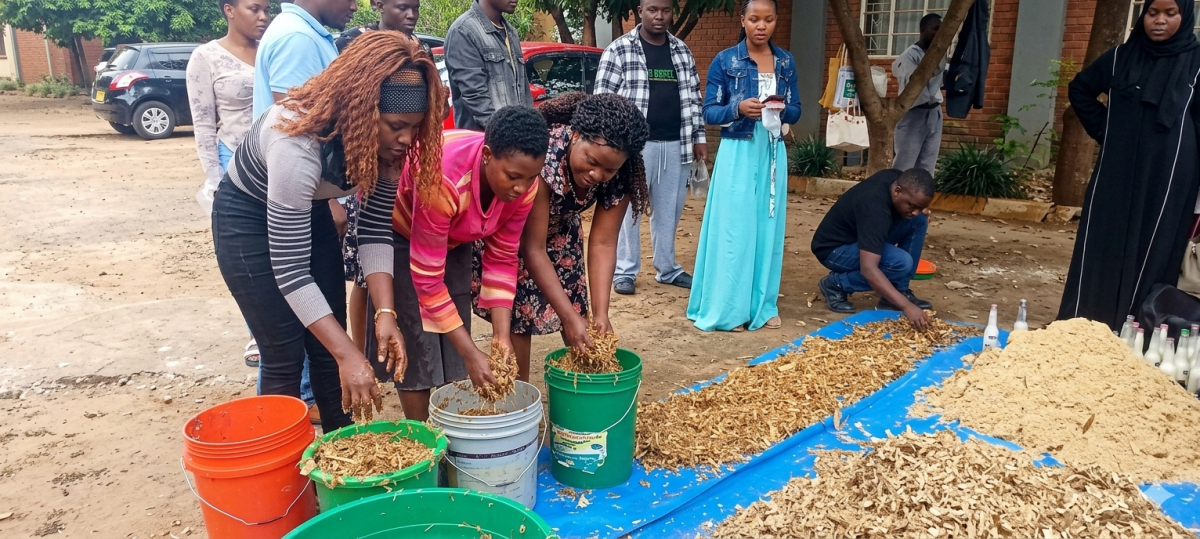
AFAP Project Officer Baba Kainga says the project is focused on equipping young people with technical skills before pushing them into the market.

“We know many young people are not economically empowered and lack practical skills,” Kainga says. “Mushroom farming can create jobs, but it requires precision and patience.”
Kainga says the expectation is that the newly trained youth should begin producing and selling mushrooms within months, helping close Malawi’s supply deficit while generating income for themselves.
For Miheso, the obsession with startup capital often misses the real problem.
“Access to capital is not necessarily the biggest limitation,” he says. “Many businesses are not properly structured. Even if you give them money, they can still collapse.”
Instead, he argues, young entrepreneurs must first master the science, understand productivity, and learn how to build sustainable businesses.
Back inside the dark incubation room, the silence eventually breaks.
After weeks of careful waiting, tiny white caps finally emerge from the sawdust bags, fragile at first, then rapidly multiplying.
For Malawi’s young mushroom farmers, that transformation carries its own symbolism: a movement from the darkness of unemployment into the possibility of self-reliance, innovation, and financial independence.