

Malawi tells government: ‘Let go’ give farmers, youth and private sector bigger voice
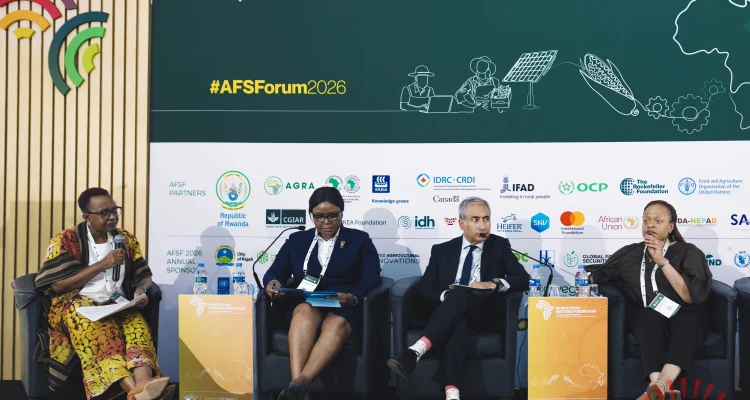
Malawi Agriculture Minister Roza Mbilizi has urged African governments to loosen their grip on policymaking and give farmers, young people, women and the private sector greater influence over decisions shaping agricultural transformation.
Mbilizi made the call during a panel discussion on agricultural transformation, arguing that governments could no longer operate as the dominant force in deciding how agriculture should develop.
“It’s high time we open up. We let go and it’s high time we became as open as possible, as inclusive as possible,” she said.
Her remarks came as the panel explored how governments could work with investors, development partners and farmers to scale up agricultural commercialisation.
Mbilizi said governments had traditionally viewed themselves as the “bosses” of policy, but argued that the ultimate purpose of laws and regulations was to serve citizens.
“Policy is for our people. The laws, the regulations, everything else is for our people,” she said.She called specifically for more space for young people, women and private-sector actors.
“Give the youth the space. Give the women the space. Give the private sector the space,” she said.
The remarks reflected Malawi’s broader attempt to reposition agriculture as a commercial sector rather than one dominated by state programmes.
The government is pushing commercialisation and mechanisation while encouraging private investors to work with smallholder farmers through cooperative and anchor-farmer arrangements.
Mbilizi said private-sector participants should therefore be involved in policy discussions because they were the actors expected to drive commercialisation.
“When we are formulating policies for commercialization … the people that are involved have to be at the decision-making table,” she said.
The argument was echoed by Sara Mbago-Bhunu, Director of the East and Southern Africa Division at the International Fund for Agricultural Development, who said successful agricultural partnerships depended on having shared platforms where governments, farmers, businesses and other stakeholders could engage directly.
She said different stakeholder groups often operated through separate forums, creating a gap between the private sector and government. The challenge, she said, was to create mechanisms through which farmers and businesses could have structured dialogue with policymakers.
The discussion also highlighted the importance of sharing risk.Mbago-Bhunu warned that agricultural transformation should not result in farmers carrying all the risks associated with climate change, market volatility and investment.
She said development partners and governments needed to develop instruments that could “derisk” farmers as they increasingly become investors and commercial players in the agricultural value chain. The emphasis on inclusion comes against the backdrop of a broader African employment challenge.
Anup Jagwani, Global Director for Farming and Agribusiness at the World Bank Group, said more than 1.2 billion people were expected to enter the workforce in coming decades, while only about 400 million jobs were projected to be available.
Agriculture, he said, would need to become an important source of employment, although many of the new jobs would arise outside the farm through inputs, irrigation, technology, processing, logistics and other services.
AgriConnect is seeking to connect 300 million farmers to markets, finance, technology and investment.
The initiative is built around an integrated approach involving governments, the private sector, infrastructure, digital systems, education and other sectors. For Mbilizi, however, integration also requires governments to change how they exercise authority.
Sometimes, she suggested, government leaders had to accept that they did not need to be at the front of every process.“Sometimes it’s good to be at the back of the bus than in your front,” she said.