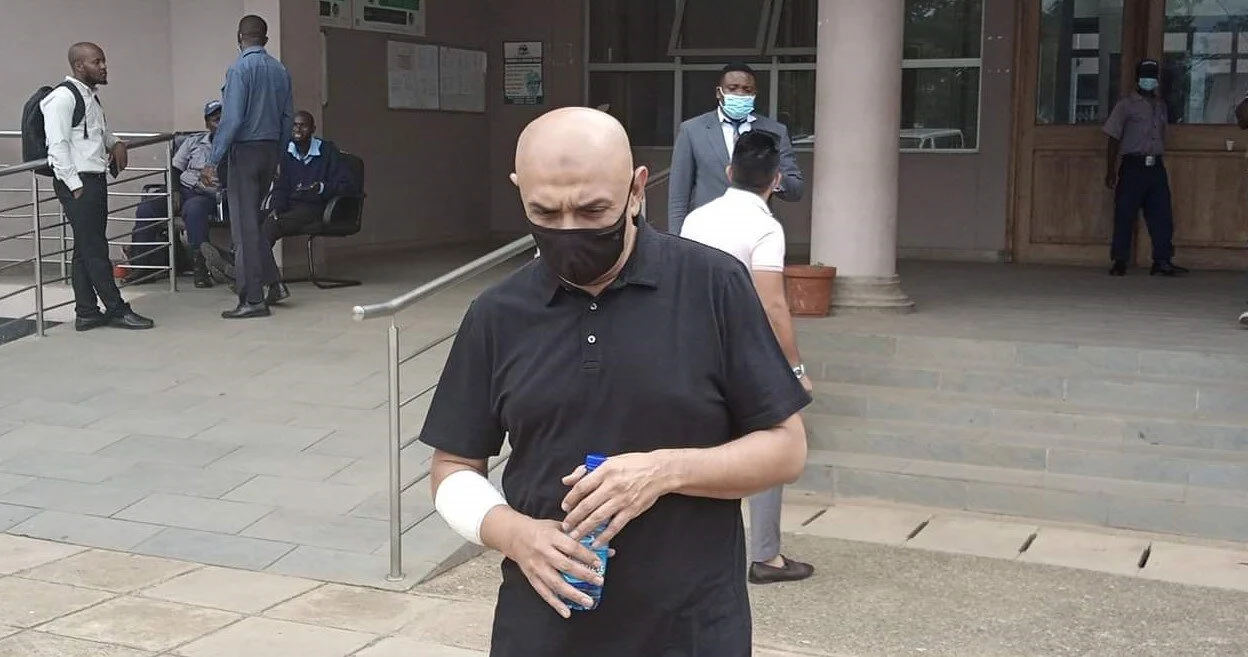


The arrest of former State Residences Chief of Staff Prince Kapondamgaga pushes investigators deeper into Malawi’s former president Lazarus Chakwera.
Kapondamgaga was not a junior official. As Chief of Staff at State Residences, he occupied one of the most influential positions in government and operated close to the centre of executive power.
His arrest comes after a series of arrests, investigations and court cases involving some of the most senior figures in Chakwera’s administration and inner circle.
Among those who have faced corruption-related investigations or arrests are former Finance Ministers Sosten Gwengwe and Simplex Chithyola Banda, former Greenbelt Authority chief executive Sam Kawale, former Secretary to the President and Cabinet (SPC) Colleen Zamba, and Richard Chimwendo Banda, the MCP Secretary General who also served as Minister of Local Government and Leader of Government Business in Parliament.
Gwengwe served as Finance Minister from 2020 until 2023 before being replaced by Chithyola. Chimwendo Banda was a cabinet minister throughout much of Chakwera’s presidency, while Zamba served as Secretary to the President and Cabinet from 2022 and became one of the most influential figures within government. Chakwera’s own runningmate, Vitumbiko Mumba was also arrested. He also served in Chakwera’s cabinent, as Minister responsible for Trade.
Together with Kapondamgaga, Chithyola, Chimwendo Banda and Zamba were widely regarded as members of the powerful circle that operated closest to the presidency during the Chakwera administration.
Many of the cases revolve around allegations that billions of kwacha were looted through public procurement, agricultural programmes, investment transactions and other government deals. The cases remain before the courts and investigations are ongoing.
Kapondamgaga’s arrest is particularly significant because his name and that of Zamba surfaced during parliamentary enquiry into the controversial acquisition of the Amaryllis Hotel, one of the largest and most contentious public expenditure decisions associated with the previous administration.
The hotel was sold to the Public Service Pension Trust Fund (PSPTF) for about K128.7 billion despite independent valuations reportedly placing its value at around K48 billion. The transaction attracted intense scrutiny and became the subject of a public inquiry.
During testimony before the inquiry, a witness recalled a meeting at Grand Palace Hotel in Mzuzu where former Secretary to the President and Cabinet (SPC) Colleen Zamba allegedly remarked that her presence and that of the Chief of Staff implied that the deal had attracted interest from “the highest office in the land.”
The witness did not explicitly state that the remark referred to Chakwera. However, references to “the highest office in the land” or “MG1” are commonly understood in Malawi’s political language to mean the Presidency.
Investigators have also alleged that some of the money at the centre of corruption scandals linked to the previous administration may have been diverted towards political activities, including campaign mobilisation and election-related operations. Those allegations remain the subject of ongoing investigations and court proceedings.
Police have not disclosed the reasons behind Kapondamgaga’s arrest and have not linked it to any specific investigation.
Politically, however, the significance is difficult to ignore. Investigators have already reached former ministers, senior civil servants, heads of state institutions and top presidential aides. Kapondamgaga’s arrest means the circle around the former president has become even smaller.
Whether the investigations ultimately stop with Chakwera’s former associates or move closer to the former president himself remains one of the biggest unanswered questions in Malawi’s anti-corruption drive.
The speculation is not new. In April, the ruling Democratic Progressive Party (DPP) claimed on its official Facebook page that Chakwera’s arrest was imminent over investigations linked to the Greenbelt Authority and fertiliser procurement scandals.
At the time, no arrest materialised and authorities did not publicly confirm the claim. However, the subsequent arrests and investigations involving some of Chakwera’s closest allies have kept questions alive about whether investigators could eventually turn their attention to the former president himself.
For now, police have not announced any investigation, charge or arrest warrant against Chakwera.